

Quick Answer: AWD (all-wheel drive) works automatically and suits everyday driving on rain, light snow, and wet highways. 4WD (four-wheel drive) uses a transfer case with low-range gearing for off-road trails, deep mud, and extreme towing. AWD costs less, burns less fuel, and needs less maintenance. Choose 4WD only if you regularly go off-road or face severe unplowed winter roads.
You’re at the dealership. The salesperson drops the question: “AWD or 4WD?” You nod confidently. But inside? Total blank. Don’t feel bad — most car buyers confuse these two systems, and picking the wrong one wastes thousands on capability you’ll never use.
Both systems send engine power to all four wheels. That part’s true. But the way they deliver that power, when they activate, and what they cost you monthly at the gas pump are completely different stories.
The global all-wheel drive market reached $28 billion in 2025 and is growing at nearly 7% annually. Over 65% of SUVs sold worldwide now come with an AWD drivetrain. Buyers clearly want better traction — but many spend money on the wrong system for their real driving conditions.
$28B
Global AWD market (2025)
65%+
SUVs worldwide with AWD
1-3 MPG
Fuel hit vs 2WD
72%
AWD/4WD sales in Colora
First: FWD, RWD, AWD, 4WD — What Do They All Mean?
Before comparing AWD and 4WD, let’s get all four drivetrain types straight. This way you’ll understand the full picture — not just two options.
FWD (Front-Wheel Drive) sends engine power to the front wheels only. It’s the most common setup on sedans and compact cars. FWD is cheaper to manufacture, more fuel-efficient, and handles light rain and snow reasonably well because the engine’s weight sits over the driven wheels. Most passenger cars on the road today use FWD.
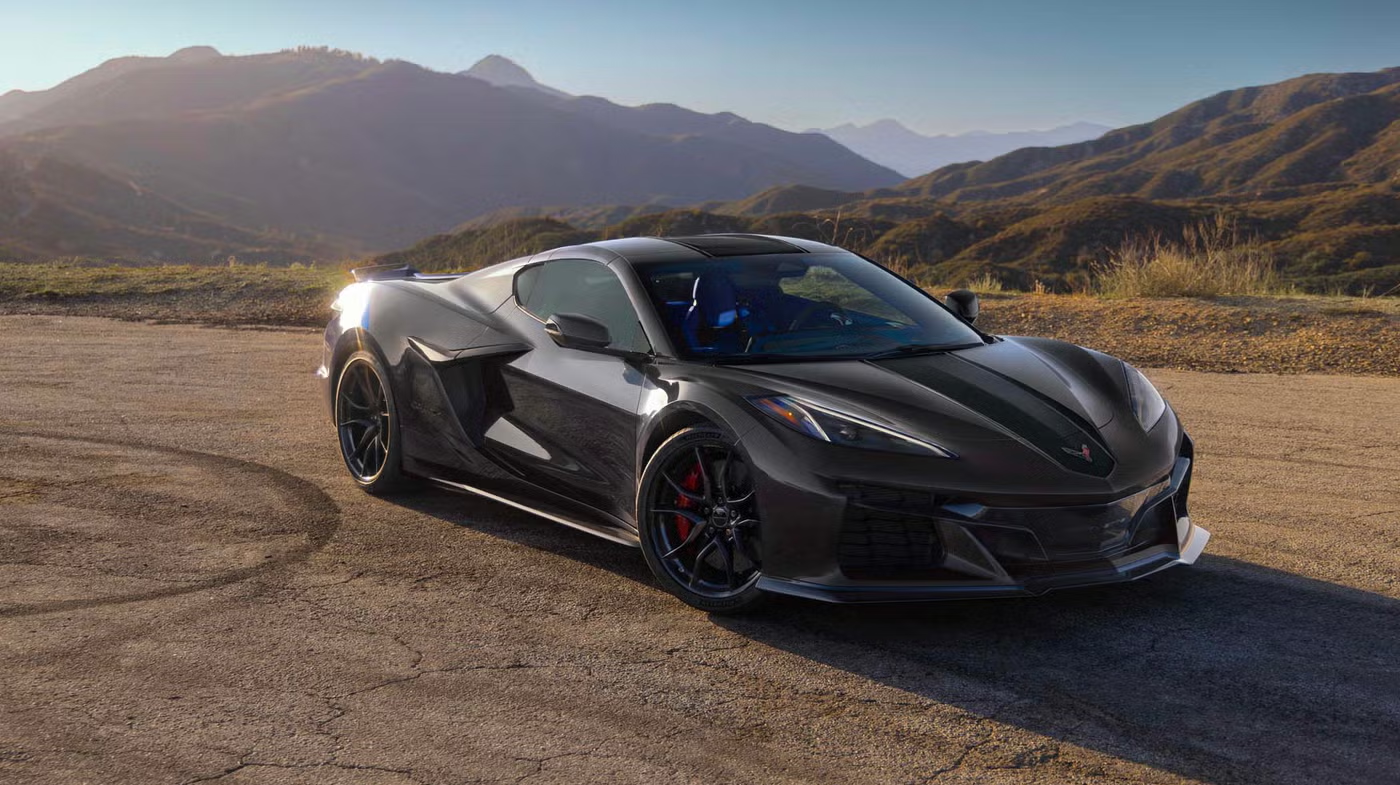
RWD (Rear-Wheel Drive) powers only the rear wheels. You’ll find it on sports cars (Chevrolet Corvette, BMW 3 Series), full-size trucks, and muscle cars. RWD offers better weight balance for performance driving, but it struggles on ice and snow because the driven wheels carry less weight.
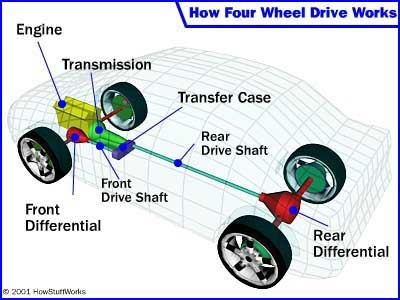
AWD (All-Wheel Drive) automatically sends power to all four wheels using a center differential and electronic sensors. It’s designed for on-road traction and works without driver input. Found on crossover SUVs, sedans, and minivans.
4WD (Four-Wheel Drive) uses a transfer case to lock the front and rear axles together. It’s built for heavy off-road use and usually requires manual engagement. Found on trucks, body-on-frame SUVs, and off-road vehicles.
Quick Rule: FWD = budget and efficiency. RWD = performance. AWD = all-weather convenience. 4WD = serious off-road and heavy towing.
A Quick History: From WWII Jeeps to Electric AWD
Four-wheel drive came first. The concept dates back to 1893 when British engineer Joseph Diplock patented an early design. But 4WD didn’t become mainstream until World War II, when the Willys MB Jeep proved that a lightweight vehicle with power to all four wheels could conquer mud, sand, and mountain trails. After the war, 4WD moved into civilian trucks, farming vehicles, and eventually SUVs.
AWD arrived much later in the passenger car world. The 1980 Audi Quattro was the breakthrough — it brought permanent all-wheel drive to a rally car and then to production sedans. Subaru followed with its Symmetrical All-Wheel Drive system across its entire lineup. By the 2000s, AWD had become standard equipment on millions of crossover SUVs.
Today, the line between AWD and 4WD keeps blurring. Electric vehicles like the Rivian R1T use individual wheel motors and software to simulate locking differentials — delivering off-road capability without a traditional transfer case. The future of all-wheel traction is increasingly electronic, not mechanical.
What Is AWD (All-Wheel Drive)?
AWD is a drivetrain that sends engine torque to all four wheels automatically. Your vehicle’s onboard computer and wheel-speed sensors constantly monitor traction. The second any tire starts slipping — on a wet highway, a gravel shoulder, or an icy intersection — the system shifts power to the wheels that still have grip.
You don’t press a button. You don’t flip a lever. It works on its own. That’s the biggest appeal of AWD: zero driver input needed.
Common AWD vehicles include the Subaru Outback, Honda CR-V, Toyota RAV4, Mazda CX-5, Hyundai Tucson, and even the Toyota Sienna minivan. Performance brands like Audi (Quattro), BMW (xDrive), and Acura (SH-AWD) use AWD for better cornering grip rather than just foul-weather safety.
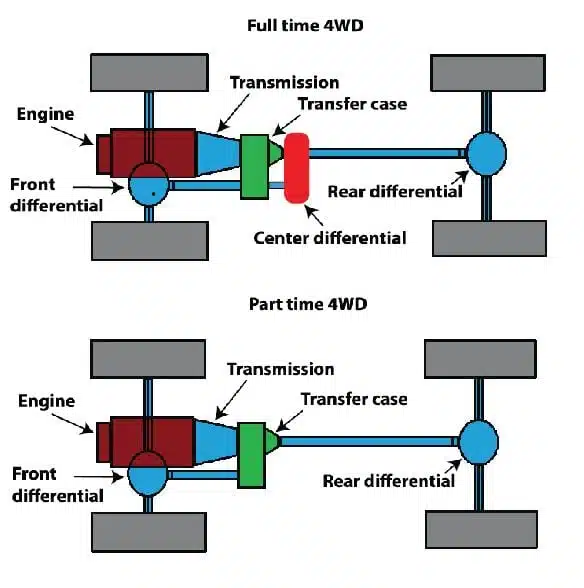
Full-Time AWD vs Part-Time AWD
Full-time AWD powers all four wheels nonstop, constantly adjusting front-to-rear torque split. Subaru’s Symmetrical All-Wheel Drive is the textbook example — standard on every model except the BRZ sports car.
Part-time AWD (also called on-demand AWD) normally drives only two wheels — usually the front. When the electronically controlled clutch pack detects wheel slip, it instantly sends power to the other axle. This saves fuel during normal driving. You’ll find part-time AWD on most unibody crossovers like the Honda CR-V and Toyota RAV4.
Some advanced AWD systems go further with torque vectoring — sending extra power to a specific individual wheel (left or right, not just front or rear) for sharper cornering. Acura’s SH-AWD and Audi’s Sport Differential are examples.
Pros of AWD
- Improved traction on wet roads, light snow, gravel, and uneven pavement
- Completely automatic — no driver input or mode selection needed
- Only 1-2 MPG fuel economy penalty vs front-wheel drive (EPA data)
- Smoother, quieter ride on highways and city streets
- Higher resale value vs two-wheel-drive versions of the same car
- Available on sedans, wagons, crossovers, SUVs, and minivans
Cons of AWD
- Adds $1,500 to $2,500 to the vehicle price (2025 Hyundai Palisade: $2,000 for AWD)
- Not built for serious off-roading — no low-range gearing, no locking differentials
- Tires must be replaced as a matched set of four (mismatched sizes damage the center differential)
- Slightly higher long-term maintenance costs from extra drivetrain components
Real-World Fuel Economy
The 2025 Hyundai Palisade with front-wheel drive: 19 city / 26 highway MPG. Add AWD: 19 city / 24 highway MPG. That’s a 2 MPG highway difference — roughly $100-$150 extra per year in gas. (U.S. News)
What Is 4WD (Four-Wheel Drive)?
4WD (also written as 4×4) is a heavy-duty drivetrain originally built for military vehicles and farm equipment. Today it powers the Jeep Wrangler, Toyota 4Runner, Ford Bronco, Ford F-150, Chevrolet Silverado, and Land Rover Defender.
The key hardware that separates 4WD from AWD is the transfer case. This is a secondary gearbox mounted behind the transmission. It connects front and rear driveshafts and locks them together so all four wheels spin at the same speed. That locked connection delivers maximum traction on loose, slippery, and rocky surfaces.
Most 4WD systems require the driver to manually engage the system using a button, dial, or floor-mounted lever. You pick the mode: 2H (two-wheel drive for normal roads), 4H (four-wheel high range for slippery roads), or 4L (four-wheel low range for crawling over obstacles).
Part-Time 4WD vs Full-Time 4WD
Part-time 4WD runs in rear-wheel drive on normal roads. You manually switch to 4WD when terrain gets nasty. Most pickup trucks (Ford F-150, Toyota Tacoma, Chevrolet Colorado) use this system. These are body-on-frame vehicles built for both work and off-road duty.
Full-time 4WD powers all four wheels continuously and uses a center differential that allows front and rear axles to rotate at different speeds on pavement. Toyota Land Cruisers and Land Rover Defenders use full-time 4WD. They also offer a selectable low range for serious off-road situations.
Some advanced rigs go even further with triple-locked configurations. Vehicles like the Mercedes-Benz G-Class and Ineos Grenadier can lock the front, center, AND rear differentials simultaneously — forcing every single wheel to turn at the same speed regardless of traction. This is the ultimate off-road setup.
What Is Low-Range Gearing?
Low-range (4L or 4LO) multiplies engine torque and slows wheel speed dramatically. It lets you crawl over boulders, climb steep loose-dirt inclines, and power through deep ruts at 2-5 MPH with precise throttle control. No AWD system offers this capability. If you need low range, you need 4WD.
What Is “Crow Hop”?
Ever hear a grinding or shuddering when turning in 4WD on pavement? That’s called crow hop (or drivetrain binding). It happens because part-time 4WD locks both axles to spin at the same speed. On dry pavement, the front wheels need to rotate faster around corners. When they can’t, the drivetrain fights itself — creating that jerky, hopping sensation. Keep doing it and you’ll damage the transfer case, axles, and driveshafts. Repair cost: $1,500 to $3,500.
Pros of 4WD
- Low-range gearing for rock crawling, deep mud, and steep climbs at walking speed
- Locking differentials force power to every wheel — even when some have zero grip
- Heavy-duty axles, driveshafts, and transfer cases built to handle extreme stress
- Superior towing traction on wet boat ramps and loose, steep grades
- Driver controls when the system engages — more flexibility across terrain types
Cons of 4WD
- Costs $2,800 to $5,000 extra (2025 GMC Sierra 2500HD: $2,800 for 4WD)
- Adds 200+ pounds to vehicle weight — increasing fuel consumption and braking distance
- Drops fuel economy by up to 3 MPG vs rear-wheel drive
- Stiffer ride on paved roads from heavier suspension and drivetrain
- Part-time 4WD must NEVER be used on dry pavement (causes crow hop and drivetrain damage)
- Higher maintenance: transfer case fluid, differential oil ($30-$50 per service), locking hub upkeep
Fuel Economy Example
The rear-wheel-drive 2025 Chevrolet Tahoe (6.2L V8): 15 city / 20 highway MPG. Add 4WD: 14 city / 18 highway MPG. Over 15,000 miles/year at $3.50/gallon, that’s roughly $250-$400 extra annually. (U.S. News)
AWD vs 4WD: Full Comparison Table
| Feature | AWD | 4WD |
|---|---|---|
| Best For | Rain, light snow, wet highways, gravel | Mud, rocks, deep snow, sand, steep trails |
| How It Activates | Automatic — no driver input | Manual button/dial/lever (some have auto) |
| Key Hardware | Center differential, viscous coupling or clutch pack, wheel sensors | Transfer case, locking differentials, heavy driveshafts |
| Low-Range Gearing | Not available | Yes — 4LO for off-road crawling |
| Vehicle Type | Unibody crossovers, sedans, minivans | Body-on-frame trucks, SUVs, off-roaders |
| Fuel Penalty | 1-2 MPG vs FWD | Up to 3 MPG vs RWD |
| Cost Premium | $1,500 – $2,500 | $2,800 – $5,000 |
| Safe on Dry Pavement? | Yes, always | Only in 2WD or full-time 4WD mode |
| Ride Quality | Smooth, quiet on highways | Stiffer, rougher on pavement |
| Towing Traction | Mild improvement | Major improvement on slippery surfaces |
| System Weight | Light (minimal impact) | Heavy (200+ lbs added) |
| Maintenance | Lower — simpler parts | Higher — transfer case, diff oil, locking hubs |
| Common Vehicles | Subaru Outback, Honda CR-V, RAV4, Mazda CX-5 | Jeep Wrangler, F-150, 4Runner, Ford Bronco |
7 Differences That Actually Matter When Buying
1. AWD Is Automatic — 4WD Needs Your Input
AWD runs silently in the background. You never interact with it. 4WD requires you to pick the right mode (2H, 4H, 4L). Engage part-time 4WD on dry pavement and you’ll get crow hop — and possibly a $1,500-$3,500 repair bill.
2. Off-Road Capability Isn’t Close
AWD handles a snowy driveway or muddy parking lot fine. But rocky trails with steep drops? It struggles. 4WD’s low-range gearing lets you crawl at 2-5 MPH with massive torque. Locking differentials keep you moving even when two wheels are in the air. That’s why every serious off-road vehicle uses 4WD.
3. The Fuel Gap Adds Up
EPA research shows AWD drops fuel economy by 1-2 MPG. 4WD drops it by up to 3 MPG. Over 15,000 miles/year at $3.50/gallon, 4WD costs $150-$400 more annually at the pump. Over 5 years, that’s $750-$2,000 in extra gas alone.
4. The Price Tags Differ
AWD adds $1,500-$2,500. The 2025 Honda CR-V charges about $1,500. 4WD is pricier — the 2025 GMC Sierra 2500HD adds $2,800. Some high-end 4WD packages on the Ford F-150 push past $4,000.
5. Maintenance Costs Diverge Over Time
AWD’s main extra cost is replacing all four tires together (mismatched sizes damage the center differential or viscous coupling). 4WD adds transfer case fluid changes, front and rear differential oil ($30-$50 per service), and potential locking hub servicing. Over 5 years, 4WD maintenance costs $300-$600 more than AWD.
6. Resale Value Depends on Geography
In Colorado, 72% of vehicles sold have AWD or 4WD. In Florida? Only about 13%. In snow-heavy and mountain states, either drivetrain significantly boosts resale. In warm states, you’re paying for a feature that won’t help you sell the car later.
7. The Towing Difference Is Real
AWD mildly improves traction during towing. 4WD makes a huge difference on steep wet boat ramps, muddy campground roads, and loose-surface grades. The locked axles and extra torque keep heavy loads moving where a two-wheel-drive truck would spin its tires.
AWD vs 4WD in Snow: Which Handles Winter Better?
AWD wins for: plowed city streets, icy highways, slushy intersections, and daily winter commuting. The automatic system reacts to wheel slip faster than any human can shift into 4WD — and it works at highway speeds without limitations.
4WD wins for: deep unplowed snow, backcountry mountain passes, and blizzard conditions where you’re breaking through drifts. Low-range gearing gives you slow, powerful control to push through heavy accumulation.
“Consider the climate where you live and the roads you typically drive. AWD is fine for most normal snow conditions. If you’ll be driving in severe snow or true off-road situations, opt for 4WD with lots of ground clearance.”— Gene Knizek, Senior Auto Test Engineer, Consumer Reports
AWD vs 4WD for Towing: When It Actually Matters
Here’s what many guides miss: the drivetrain matters for towing traction, not towing capacity. Your vehicle’s maximum tow rating is determined by the engine, transmission, frame, and cooling systems — not whether you have AWD or 4WD.
But traction while towing is a different story. If you’re backing a boat trailer down a steep, wet launch ramp — 4WD keeps all four wheels gripping while a two-wheel-drive truck spins helplessly. Same for hauling a camper through muddy campground roads or pulling a trailer up a gravel mountain road.
If you tow on dry highways: Drivetrain doesn’t matter much. Focus on tow rating and engine power.
If you tow on wet, steep, or loose surfaces: 4WD provides dramatically better grip. AWD helps slightly but can’t match 4WD’s locked-axle traction.
Why Winter Tires Matter More Than Your Drivetrain
This is the most important section in this entire guide. Here’s the truth that dealerships won’t tell you:
AWD and 4WD only help you accelerate on slippery roads. They do absolutely nothing to improve your braking distance. And they only slightly improve cornering grip. A front-wheel-drive car on proper winter tires will stop 30-40% shorter on ice than an AWD vehicle on all-season tires.
Think about it. What matters more — getting moving from a stoplight, or being able to stop when a car pulls out in front of you? The answer is obvious. Your tires are your only contact with the road. No drivetrain technology changes that.
Best Winter Setup: AWD + dedicated winter tires. This gives you automatic acceleration traction PLUS the braking and cornering grip that AWD alone cannot provide. Budget for the tires, not just the drivetrain upgrade.
Electric Cars Are Changing the AWD Game
Electric vehicles deliver AWD through dual motors — one per axle. No transfer case. No heavy driveshaft. No center differential. Just instant torque to whichever wheel needs it. The result: EV-based AWD barely hurts efficiency compared to single-motor versions.
Vehicles like the Tesla Model 3, Hyundai Ioniq 5, and Kia EV6 offer electric AWD that responds faster than any mechanical system. Electric trucks like the Rivian R1T go even further with four individual wheel motors and software-controlled torque vectoring that mimics locking differentials — delivering legitimate off-road capability through code rather than hardware.
For buyers who want all-weather traction without the fuel penalty, electric AWD is the biggest shift in drivetrains since Audi introduced the Quattro in 1980.
4 Expensive Mistakes to Avoid
Mistake #1: Buying 4WD When You Never Leave Pavement
If your toughest driving is a rainy school run, 4WD is expensive overkill. AWD handles that perfectly at a fraction of the upfront cost, fuel penalty, and maintenance burden.
Mistake #2: Thinking Drivetrain Replaces Winter Tires
AWD and 4WD help acceleration. They do nothing for braking. A front-wheel-drive sedan on winter tires outbrakes an AWD SUV on all-seasons every single time on ice. Always budget for tires, not just a drivetrain upgrade.
Mistake #3: Running Part-Time 4WD on Dry Pavement
Locking both axles on dry roads creates crow hop — binding stress that can destroy the transfer case, axles, and driveshafts. One afternoon of dry-road 4WD can cause $1,500-$3,500 in damage.
Mistake #4: Ignoring Total Ownership Costs
The sticker price is just the start. Add the fuel penalty ($150-$400/year for 4WD), matched tire replacements, transfer case servicing, and differential oil changes. Over 5 years, 4WD adds $1,000-$3,000 beyond a two-wheel-drive version of the same vehicle.
Quick Quiz: Which System Fits Your Life?
Match Your Lifestyle to the Right Drivetrain
“I drive highways and city streets 95% of the time”→ AWD
“I hit dirt trails and backcountry roads most weekends”→ 4WD
“We get moderate snow 3-4 months per year”→ AWD + winter tires
“I tow a boat on steep, wet ramps regularly”→ 4WD
“I want something automatic that just works”→ AWD
“I drive through deep mud, sand, or rocky terrain”→ 4WD
“Gas mileage is a top priority”→ AWD (or electric AWD)
“I live in Florida, Arizona, or Southern California”→ Probably neither — save the money
Step-by-Step: How to Choose
Step 1: Audit Your Actual Driving
Look at the last 12 months. Where did you actually drive? If 90%+ was paved roads — AWD covers you completely.
Step 2: Check Your Local Weather
Light-moderate snow that gets plowed? AWD plus winter tires is the sweet spot. Deep backcountry snow and unplowed mountain roads? 4WD earns its keep.
Step 3: Calculate the Real Cost
Add up: sticker premium + fuel penalty over 5 years + maintenance difference. AWD saves $1,000-$3,000 in total ownership costs vs 4WD.
Step 4: Factor in Resale Geography
Buying in Denver? AWD/4WD adds real resale value. Buying in Miami? The extra cost won’t come back when you sell.
Bottom Line: About 80% of drivers are perfectly served by AWD. It costs less, uses less gas, rides smoother, and works automatically. Pick 4WD only if you regularly tackle off-road trails, tow on slippery surfaces, or face extreme unplowed winter roads. Don’t pay for capability you’ll never use.
Frequently Asked Questions
Is AWD the same as 4WD?
No. AWD uses a center differential and electronic sensors to automatically send power where it’s needed. 4WD uses a transfer case to lock front and rear axles together, usually needing manual engagement. AWD is designed for on-road traction on unibody vehicles. 4WD is built for off-road terrain on body-on-frame trucks and SUVs.
Is AWD or 4WD better for snow?
AWD handles plowed snowy roads and icy highways automatically. 4WD is better for deep unplowed snow thanks to low-range gearing and locking differentials. For most city and suburb drivers, AWD paired with winter tires provides the best all-around winter safety.
Does AWD use more gas than 4WD?
No — AWD uses less. AWD costs 1-2 MPG vs front-wheel drive. 4WD drops fuel economy by up to 3 MPG due to a heavier transfer case and extra driveshafts. Part-time 4WD reduces the penalty since it runs in two-wheel drive mode most of the time.
Can you drive 4WD on dry pavement?
Only with full-time 4WD that has a center differential (like Land Rover or Toyota Land Cruiser). Never engage part-time 4WD on dry roads — it locks both axles to the same speed, creating a binding phenomenon called “crow hop” that damages the transfer case, axles, and driveshafts.
How much does AWD or 4WD add to the price?
AWD adds $1,500-$2,500 (Honda CR-V: ~$1,500, Hyundai Palisade: $2,000). 4WD costs $2,800-$5,000 (GMC Sierra 2500HD: $2,800). Beyond sticker price, factor in reduced fuel economy, matched tire sets, and transfer case servicing for 4WD.
Do AWD/4WD vehicles hold resale value better?
Yes, especially in northern and mountain states. In Colorado, 72% of cars sold have AWD/4WD. In Florida, only about 13%. The resale premium depends entirely on local demand for all-weather capability.
What is a transfer case?
A secondary gearbox mounted behind the transmission in 4WD vehicles. It splits engine power between the front and rear driveshafts. Most offer 2H (two-wheel high) for normal driving, 4H (four-wheel high) for slippery roads, and 4L (four-wheel low) for slow off-road crawling with maximum torque.
Does AWD replace winter tires?
No. AWD only helps acceleration on slippery surfaces. It does nothing for braking distance or cornering grip. A front-wheel-drive car on winter tires stops shorter and handles better on ice than an AWD vehicle on all-season tires. For real winter safety, combine AWD with dedicated snow tires.
Is AWD or 4WD better for towing?
4WD provides far better traction when towing on slippery surfaces — steep wet boat ramps, muddy campground roads, and loose gravel hills. For highway towing on dry pavement, the drivetrain matters less than engine power and the vehicle’s maximum tow rating.
What do FWD, RWD, AWD, and 4WD stand for?
FWD = front-wheel drive (power to front wheels only). RWD = rear-wheel drive (power to rear wheels only). AWD = all-wheel drive (automatic power to all four, on-road focused). 4WD = four-wheel drive (lockable power to all four, off-road focused). Most passenger cars use FWD. Most trucks and off-road SUVs use 4WD.






Leave a Reply