
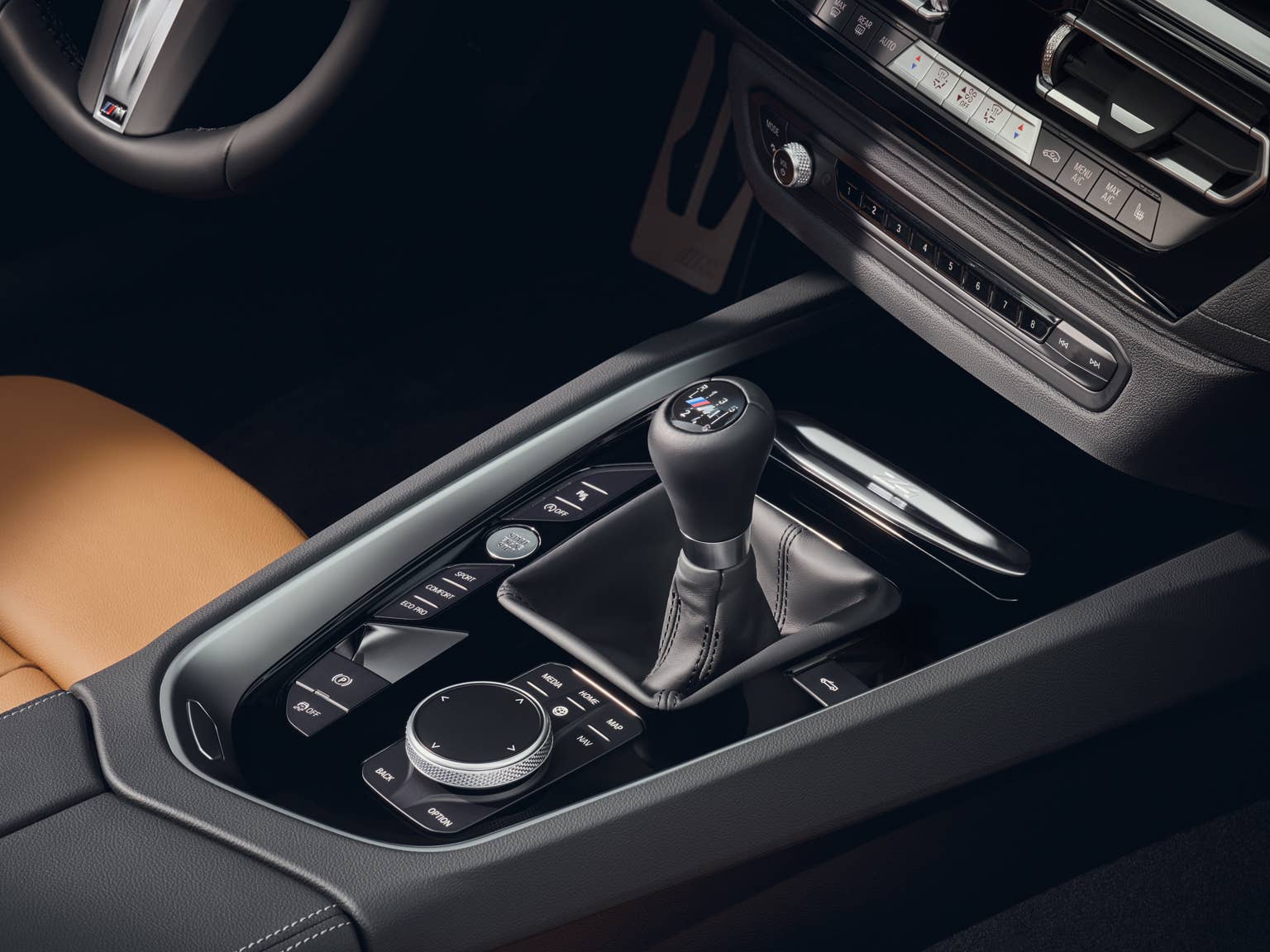
BMW’s M division has confirmed that its engineers are actively working to keep the manual transmission available in future performance cars. Sylvia Neubauer, Vice President of Customer, Brand, and Sales at BMW M, made the announcement in April 2026 during an interview with German trade publication Automobilwoche.
Why the BMW M Manual Transmission Faces a Threat
Modern BMW M engines now produce more torque than a traditional manual gearbox can safely handle. The current 3.0-liter twin-turbocharged S58 inline-six makes 553 horsepower. In automatic models, it delivers around 650 Nm of torque. But manual versions are capped at 550 Nm to protect the gearbox from damage.
That gap of roughly 100 Nm means manual drivers get less power than those who choose the automatic. BMW M boss Frank van Meel has said that manual gearboxes no longer make sense from an engineering standpoint. The sports car segment is increasingly moving toward dual-clutch and torque-converter automatics that can handle higher output.
Which BMW Models Still Offer a Manual?
Right now, three BMW M cars come with a six-speed manual option. The BMW M2, M3, and M4 all let buyers choose three pedals. The BMW Z4 M40i also offered a manual, but that model’s production was extended only through May 2026 after originally being scheduled to end in October 2024.
The M2 CS, however, dropped the manual entirely. BMW said the car’s full engine output was too much for the six-speed gearbox. That decision gave enthusiasts a clear signal that rising power levels could eventually kill the stick shift across the entire M lineup. Understanding how different drivetrain systems work helps explain why matching transmission to output is so critical.
BMW M Promises a Solution for Manual Fans
Despite the challenges, Neubauer promised that BMW M will find a way forward. She confirmed that engineers are working to ensure manual gearboxes can survive alongside increasingly powerful engines. One likely approach is limiting engine output in manual versions, a strategy BMW already uses in the current M2.
Building an entirely new, stronger manual gearbox is not realistic. The production volumes are too low to justify the cost. Suppliers are also reluctant to manufacture manual transmission parts in small quantities. The demand for manuals is largely concentrated in the United States, with global volumes too thin to support major investment.
What Manual Transmission Fans Should Know
If you want a new BMW M car with a manual, now is the time to act. The M2 and M4 are expected to stay in production for about three more years with the manual option. After that, the next-generation M3 with a six-cylinder engine is expected around 2028, but there is no guarantee it will offer a stick shift.
Stricter Euro 7 emissions rules add another barrier. These regulations favor automatic transmissions because they allow more precise control over engine output and fuel consumption. Modern driver-assistance systems are also built around automatics, making it harder to integrate a manual into new platforms. The next Nissan GT-R and other upcoming performance cars face similar questions about transmission choices.
What Happens Next for BMW M Manuals
BMW has not shared a timeline for its engineering solution. The company has only confirmed that work is underway. For now, the M2, M3, and M4 remain the last line of defense for the three-pedal BMW experience. The competitive landscape is shifting fast, and BMW knows that keeping the manual alive is as much about brand identity as it is about engineering.
As long as enough buyers keep choosing the manual, BMW says it will keep offering one. But the window is narrowing. Enthusiasts who care about saving the stick shift should put their money where their passion is — and order one while they still can.
Follow AutoGearAlert for the latest updates on BMW M performance cars and manual transmission news.




Leave a Reply