
How to Choose the Right Tyre for Your Car? It is one of the most critical decisions that will influence its safety, fuel efficiency, comfort in driving, and ultimately, vehicle performance.
Tyres are nothing but a black circle of rubber, nor do they represent some form of art but, in reality, it has turned out to be an art form of design, engineering, and material science.
They are the only part of the vehicle that makes contact with the road surface, so their quality and suitability will directly affect how your car handles, brakes, and consumes fuel. This authoritative guide covers How to Choose the Right Tyre for Your Car.
1. Why Tyres Matter More Than You Think
Tyres are the foundation of your overall driving experience. This is why How to Choose the Right Tyre for Your Car is important:
Safety
A tyre is the most critical contact area a car makes with the road. The right tyres allow for the best grip and braking, saving lives from accidents that often occur due to bad weather conditions such as rain or snow.
Fuel Efficiency
Tyres that have low rolling resistance minimize the effort needed to take the car forward. Although it may not seem like much, over the lifetime of a tyre, it can mean thousands of pounds saved in fuel over its life.
Comfort
The proper tyres ensure that the latter eliminate all kinds of vibrations and noise, and assure a smoother ride with a pleasure factor incorporated in it.
Long- Lasting
Tyres that are dependent upon certain specific driving conditions tend to last longer. Thus, these will not burden you with frequent replacements.
2. Familiarity with Tyre Basics: Decoding Tyre Markings
Each tyre carries its alphanumeric codes on the sidewall, which detail the tire’s specifications. It is the first step towards How to Choose the Right Tyre for Your Car? and needs.
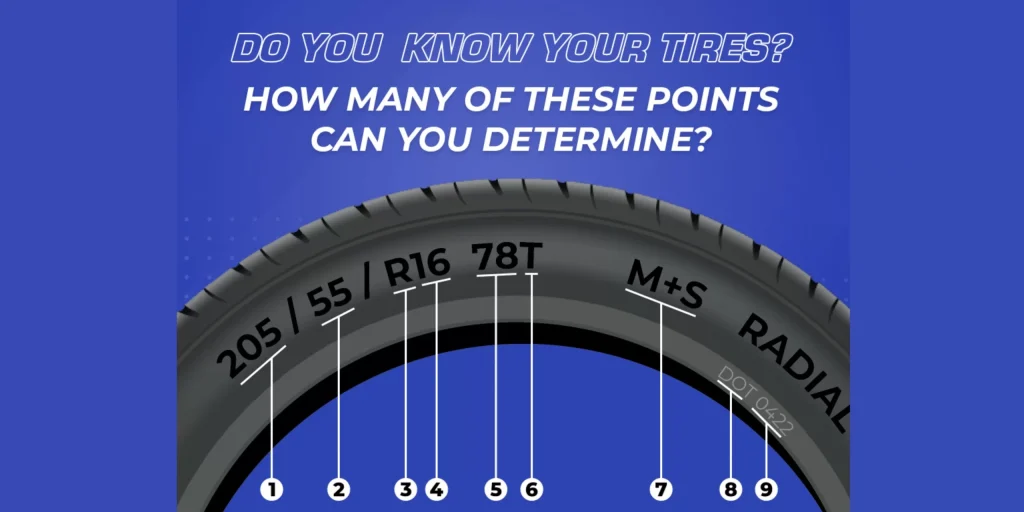
Example: 195/65 R15 91H
- 195: Width of tyre, in millimetres.
- 65: Aspect ratio. The sidewall height expressed as a percentage of the width.
- R:Radial construction. Nowadays the most common.?
- 15: Diameter of rim in inches
- 91: Load index. The maximum weight the tire can support.
- H: Speed rating. The maximum speed the tire can handle safely (e.g., H = 210 km/h). Any further important markings
Additional Key Markings:
- Treadwear Indicator (TWI): Shows how much your tyre resists wear. The higher the number, the longer the tread will last.
- Temperature and Traction Ratings: These give an indication of the ability of the tyre to dissipate heat and grip.
- Manufacture Date: This is usually expressed in a four-digit format, such as 0423, meaning that the tyre was manufactured in the 4th week of 2023. Do not buy tyres more than 3-5 years old.
3. Determine Your Driving Needs
Where you live, the time of day you drive, and how much you drive all play a huge role in finding How to Choose the Right Tyre for Your Car. Consider these factors:
City Driving
City driving involves constant starts, stops, and low speeds. Here’s How to Choose the Right Tyre for Your Car in city:
- Urban settings should have durability and wet grip due to slippery roads
- Noise levels are a must for quiet cabin environments in city driving
Highway Driving
Long drives need tires that can run at those speeds and for extended periods of comfort therefore How to Choose the Right Tyre for Your Car fore long drives:
- Low rolling resistance tyres for better fuel economy
- Noise Cancelling tread compounds in the variant
Off Road or Off-Road Driving
How to Choose the Right Tyre for Your Car? If you wish to drive off road on mud or rocky surfaces, you may need
- A/T tyres that would offer highway and off-road comfort equally
- M/T tyres for severe off-road applications with high sidewall puncture resistance
Weather Conditions
- Summer Tyres: Deliver exceptional performance on warm, dry, or wet roads; however, it gets pretty hard and loses grip when freezing.
- Winter Tyres: Its rubber composition remains soft to enable better grip on snowy, icy, or frozen conditions.
- All-Season Tyres: Take the middle road alternative for places where the climate conditions are relatively not too varied.
4. Pair Tyres with Your Car
Every tyre has a manufacturer’s recommended specification for a car to deliver optimum performance.
Additional Key Markings
Look up your owner’s manual or the placard inside the driver’s door for:
- Tire size
- Load index
- Speed rating
OEM Tyres
The car manufacturer installs tires that are designed to create a combination of all three performance factors. If you like the OEM tires, install the same type
Performance Improvements
If you are looking to upgrade to bigger or performance-oriented tyres, ensure that it fits in your car’s design and suspension. Incorrect-sized tyres may result in reduced performance in handling, mileage, and safety.
5. Suitable Tyre Type
Tubeless tyre vs tube-type tyre
- Tubeless Tyres: Safer and more efficient as air is retained longer in case of a puncture and less fuel consumption.
- Tube-Type Tyres: An older technology, most likely to occur an immediate deflation on a puncture.
Run-Flat Tyre
Run-flat tyres allow you to cover a small distance in case of a puncture. It is pretty suited for careful drivers.
Radial vs Bias-Ply Tyres
Radial Tyres:
Stock fit for the family vehicles, these tyres claim more mileage and long life.
Bias-Ply Tyres:
Rarely seen on the recent car models but are still used in heavy-duty operations.
6. Tyre Features Analysis
Tread Pattern
The design of the tread determines how it functions like a friction generator when braking as well as against hydroplaning
Tread Pattern
- Symmetrical: Basic, quiet, and durable for day-to-day road use.
- Asymmetric: Combines wet grip and cornering stability; best for sports cars.
- Directional: Suitable for wet roads and high-speed performance.
Tyre Compound
Soft compounds have great grip but degrade faster. Hard compounds can last longer but reduce traction.
Wet vs Dry Performance
For rainy areas, look for tyres with a more prominent wet grip ratings and resistance to aquaplaning.
7. How to Choose the Right Tyre for Your Car?
Budget Considerations
Tyres also come in various price ranges. How to Choose the Right Tyre for Your Car? Would depend on the amount you’re willing to pay for performance and durability:
- Premium Tyres: These come with big brands like Michelin, Bridgestone, and Continental, offering high-end safety quality, performance, and durability with a price.
- Mid-Range Tyres: These are fitting options like Hankook or Yokohama, acting as a compromise between quality and affordability.
- Budget Tyres: These are fitted only because it is cheap and may compromise on the performance and life time of the tyre.
While higher priced tyres are more expensive, strength and performance may pay back in the long run.
8. Tyre Ratings and Certifications
Energy Efficiency
Look for EU labelling or equivalent for comparing tyre performance in aspects:
- Rolling resistance (Fuel Efficiency)
- Wet grip (Safety)
- Noise levels (Comfort)
- Load and Speed Ratings
Tyres’ load index and speed rating should be equal to or greater than that of the car’s.
9. How to Choose the Right Tyre for Your Car?: Avoid Common Tyre Mistakes
Wrong Application of Mismatched Tyres
All four tyres must be the same kind, of course, size and make. Tyres mismatched can affect the vehicle’s bad handling as well as uneven wearing.
Neglecting Seasonal Needs
Installing summer tyres in winter, or vice versa, sacrifices safety and performance.
Failure to Replace tyres When Needed
Tyres with excessive tread-wearing or sidewall-damage need to be replaced immediately if tread is all right.
10. Maintenance Care
Proper maintenance increases the life of your tyres and makes them perform better therefore How to Choose the Right Tyre for Your Car? should be done while keeping maintenance in mind.
Check Tyre Pressure
Inflating your tyres under-deflated generates more wear and consumes more fuel. The tyre becomes less grippy and reduces ride comfort if over-inflated. Check for pressure on a regular basis with a pressure gauge to know How to Choose the Right Tyre for Your Car.
Rotate Tyres
Tires need to be rotated every 8,000–10,000 km to maintain wear evenly on all the four tyres.
Check Tread Depth
After it falls below the legal minimum level of 1.6mm in most countries, you need to change your tyres.
Wheel Alignment and Balancing
Misaligned wheels cause uneven wear and affect handling. Balancing prevents vibrations at high speeds.
11. Where to Buy Tyres
Online Retailers
- Advantages: Extensive range of tyres, competitive pricing and doorstep delivery.
- Disadvantages: Does not have installation options.
Authorized Dealers
- Advantages: Professional advice on How to Choose the Right Tyre for Your Car? and installation immediately.
- Disadvantages: May be more expensive than online stores.
Specialized Tyre Outlets
Provide personalized suggestions for How to Choose the Right Tyre for Your Car? and professional fitting.
12. How to Know when it’s Time to Replace Your Tyres
Even the best tires become worn and could potentially need replacing over time. Knowing when to replace them is key to safety and performance.
When To Replace Your Tyres
- Tread Wear: Measures using a tread depth gauge. Ensures that the depth of the tyre is more than the minimum recommended by the law of 1.6 mm, although 2.5 mm is the ideal for safe aspects. Many tyres come fitted with tread wear indicator. These are little bars showing just above the tread when the tyre needs to be changed.
- Cracks or Bulges: Obvious cracks in rubber and bulges on sidewalls might indicate structural damage.
- Punctures that reappear: If you continue to get a punctured tyre, it may result due to the wear of tread or old rubber .
- Worn Tread Pattern: It may result in alignment or suspension problems and also be an indicator when the tyres are to be replaced.
- Tyre’s Age: Tyres should be replaced after 5–7 years no matter how they look, because the rubber is degrading .
13. Green Tyre Options: Eco-Friendly Choices
As environmental awareness persists, green alternatives have turned out to be a requirement for tyre producers that may lessen their ecological impact. How to Choose the Right Tyre for Your Car while keeping the environment in mind:
Eco-Friendly Tyre Characteristics
- Low Rolling Resistance: Tyres engineered for minimizing rolling resistance help to maximize fuel usage while lowering carbon emissions
- Waste Material: A few employ recycled rubber and environmentally friendly production procedures during the making
- Increased Lifespan: Long-lasting durability of tyres reduces waste through extended life
- Biodegradable Content: This type of tyre is made using materials that break down more readily in the environment
Environment-Friendly Tyre Companies
Tyres carry such certifications as EU energy labels or endorsements from sustainability-focused organizations. Brands such as Michelin, Bridgestone, and Goodyear have launched their respective green ranges.
How to Choose the Right Tyre for Your Car?
has something to do with understanding your vehicle, assessing the conditions under which you drive, and prioritizing safety and comfort. Therefore, knowing How to Choose the Right Tyre for Your Car?
The specifications of your tires, how it will perform in various weather conditions, and how you drive may just be what you need to make that decision of How to Choose the Right Tyre for Your Car?.
Not only do the right tyres save you money, but they also enhance your driving experience, safety, and lower long-term costs.
No matter if you drive primarily in the city, have a highway route to get you to your destination, or enjoy off-roading; there is one tyre out there that will fit the bill for your needs. Take your time, do some research, and make a decision of How to Choose the Right Tyre for Your Car? that keeps you safe and satisfied on every journey. You can check other guide to know How Much To Tint Car Windows









Leave a Reply