
You need a car. Your credit score says “not so fast.” Sound familiar?
Nearly 15% of Americans who financed a vehicle in 2025 had credit scores below 601, according to Experian. That’s millions of real people — not statistics — who figured out how to get car loans despite bad credit.
Here’s the truth most articles won’t tell you: bad credit doesn’t lock you out of car ownership. It just changes the game you’re playing. And if you play it smart, you can save thousands of dollars even with a low score.
This guide breaks down every option available to you right now in 2026. No fluff. No sugarcoating the costs. Just real strategies that work.

What Counts as “Bad Credit” for Auto Loans?
Let’s get specific. FICO defines bad credit as a score under 580. But every lender draws the line differently.
Here’s how most auto lenders break it down:
- Super Prime (781–850): You get the best rates. Lucky you.
- Prime (661–780): Still solid. Most lenders roll out the welcome mat.
- Near Prime (601–660): Rates get noticeably higher. Still manageable.
- Subprime (501–600): Fewer options. Higher rates. Bigger down payments expected.
- Deep Subprime (300–500): The toughest spot. But loans still exist.
Your credit score matters — a lot. But it’s not the whole picture. Lenders also look at your income, how long you’ve held your job, your existing debts, and how much you can put down upfront.
The Real Cost of a Bad Credit Car Loan
This is where things get uncomfortable. But you need to see these numbers before signing anything.
According to Experian’s Q4 2025 data, here’s what borrowers pay on average based on their credit tier:
New Car Loan Rates:
- Super Prime: ~4.66% APR
- Deep Subprime: ~16.01% APR
Used Car Loan Rates:
- Super Prime: ~6.82% APR
- Deep Subprime: ~21.85% APR
What does that look like in your wallet?
Take a $25,000 used car financed for 60 months:
- Good credit (6% APR): ~$483/month | ~$3,980 total interest
- Bad credit (19% APR): ~$648/month | ~$13,880 total interest
That’s roughly $10,000 more for the exact same car. Let that sink in.
This isn’t meant to scare you away from buying. It’s meant to arm you with the information you need to negotiate harder, shop smarter, and avoid getting ripped off.
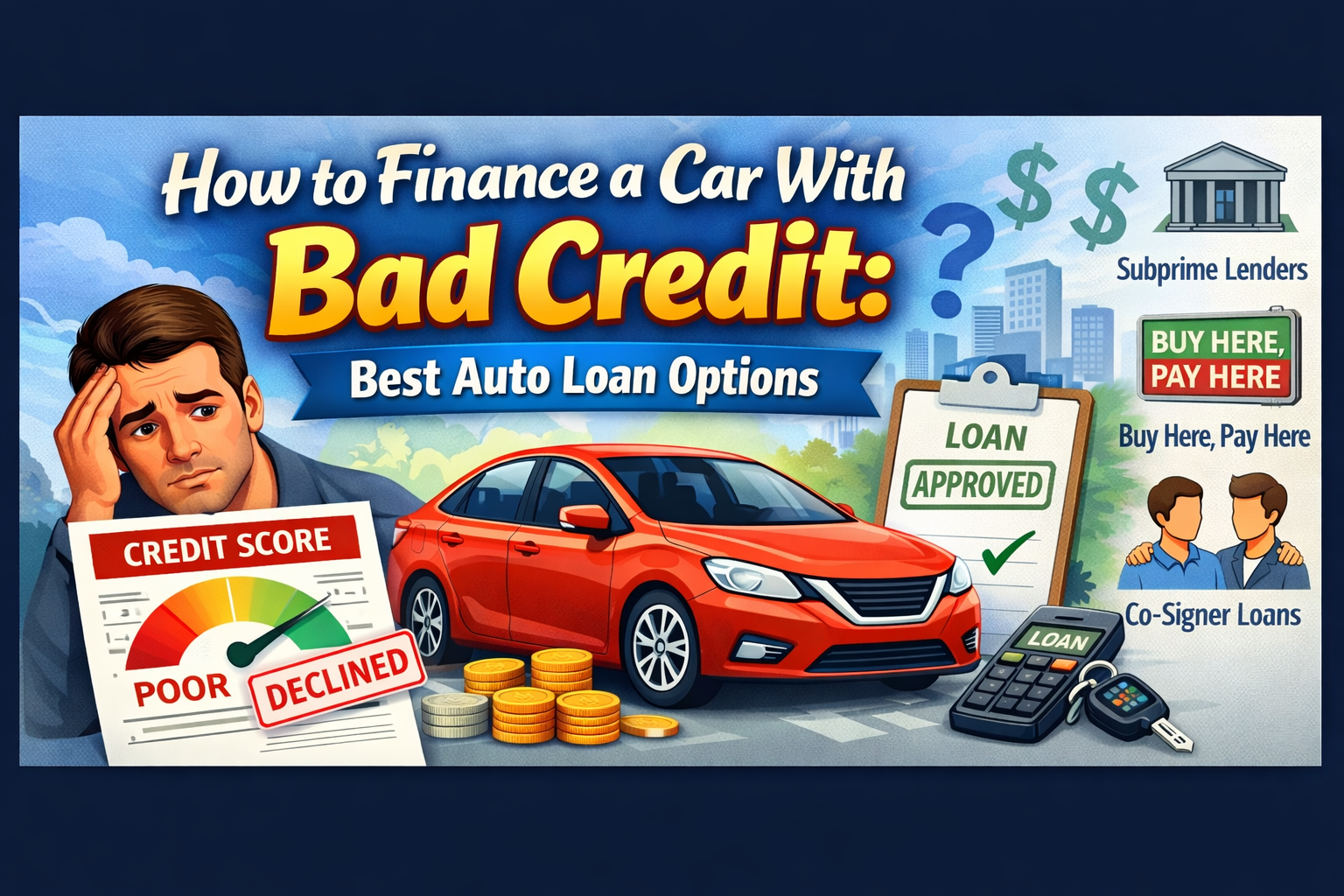
7 Best Auto Loan Options for Bad Credit in 2026
Not all lenders treat bad credit the same way. Some specialize in it. Here are your best bets right now.
1. Credit Unions — Your Secret Weapon
Credit unions are member-owned. They’re not trying to maximize shareholder profits. That means they often offer lower rates and more flexible terms to people with imperfect credit.
Why they stand out:
- Rates are typically 2–5% lower than banks for subprime borrowers
- Many will consider your overall financial picture, not just your FICO score
- Some offer “credit builder” auto loans designed to help you improve your score while you drive
Best pick: Digital Federal Credit Union (DCU) offers the same APR for new and used cars, finances up to 130% of the vehicle’s value, and accepts co-borrowers. You can join by signing up for a partner nonprofit for as little as $10.
The catch: You need to be a member. But joining is usually cheap and easy.
2. Online Loan Marketplaces — Cast a Wide Net
These platforms let you submit one application and get matched with multiple lenders. It’s the fastest way to comparison shop.
Top marketplaces for bad credit:
- Autopay: No minimum credit score listed. Prequalification with no credit impact. No payments for 45 days after purchase. Loan terms from 2 to 8 years.
- myAutoLoan: Minimum 600 credit score. Compares up to four offers. Supports private party purchases and lease buyouts.
- Auto Credit Express: Specifically built for borrowers with past bankruptcies, repossessions, and very low scores. Connects you with local dealers who specialize in subprime lending. Holds an A+ BBB rating.
Why this approach works: Different lenders have different risk appetites. One might reject you while another offers reasonable terms. Casting a wide net increases your odds.
3. Capital One Auto Finance — Big Bank, Low Floor
Capital One sets its minimum credit score requirement at just 500. That’s one of the lowest among major banks.
Key details:
- Loan terms from 24 to 84 months
- Loans start at $4,000
- No early payoff penalties
- Prequalification available without a hard credit pull
The catch: You can only use Capital One auto loans at their partner dealerships. If you have a specific car or dealer in mind, this might not work.
4. Carvana — Buy and Finance in One Place
Carvana combines the car shopping and financing experience into a single platform.
What makes it work for bad credit:
- No minimum credit score requirement published
- Prequalification available (soft pull, no credit impact)
- Prequalification offers are valid for 30 days
- Allows co-borrowers for better rates
Requirements to know:
- Minimum income of $10,000 per year
- No active bankruptcies
- No prior Carvana loan defaults
- Used cars only (from their inventory)
5. CarMax — No Minimum Score Required
CarMax doesn’t list a minimum credit score at all. If you’re breathing and have income, they’ll consider you.
Perks:
- Over 250 physical locations plus full online shopping
- Check rates without affecting your credit
- Add a co-borrower anytime to improve approval odds
The limitation: You’re restricted to CarMax’s inventory. No outside vehicles.
6. Buy Here, Pay Here (BHPH) Dealerships — Last Resort Only
BHPH lots handle both the selling and financing in-house. They approve based on income, not credit score. Some even accept multiple payments per month to match your pay schedule.
When it makes sense:
- Your score is below 500
- Every other lender has turned you down
- You need a car immediately
The danger zone:
- Interest rates can exceed 25%
- Vehicle selection is limited (and often older, higher-mileage cars)
- Missing a single payment can trigger immediate repossession
- These loans often don’t report positive payment history to credit bureaus — so you won’t rebuild your credit
Use BHPH only when you’ve exhausted every other option.
7. Dealership Financing — Use It Strategically
Most people end up financing through the dealership. Finance officers there have relationships with dozens of banks and credit unions. They can sometimes find you a deal that direct lenders can’t.
The smart play: Walk in with a pre-approved offer from an outside lender. Then ask the dealer’s finance office to beat it. This creates competition and usually gets you a better rate.
Watch out for: Dealer markup on interest rates. Finance officers can legally add a percentage on top of whatever the lender actually offered. Always ask what the “buy rate” is versus the rate they’re quoting you.
5 Strategies to Get the Best Deal Despite Bad Credit
Having bad credit doesn’t mean you have to accept whatever terms land in your lap. These tactics can save you thousands.
Strategy 1: Save for a Real Down Payment
The math here is simple. The less you borrow, the less risk the lender takes on. And lower risk means lower interest rates.
Even a 10–15% down payment dramatically improves your approval odds and terms. On a $20,000 car, that’s $2,000–$3,000 upfront.
Pro tip: A trade-in counts as a down payment. Even a car worth $1,500 helps.
Strategy 2: Get a Co-Signer
A co-signer with good credit essentially vouches for you. They’re agreeing to take over payments if you can’t. This lowers the lender’s risk and often unlocks much better rates.
Important: Not every lender accepts co-signers. Confirm this before applying. And make sure your co-signer understands exactly what they’re agreeing to. Missed payments hit their credit too.
Strategy 3: Get Pre-Qualified Everywhere
Pre-qualification uses a soft credit pull. It doesn’t hurt your score. Do it with as many lenders as possible before visiting a dealership.
Why? Because walking in with competing offers gives you leverage. Dealers will try harder to earn your business when they know you have alternatives.
Strategy 4: Keep the Loan Term Short
Longer terms mean lower monthly payments. Tempting. But they also mean paying way more interest over the life of the loan.
A 72-month loan on a used car with bad credit can cost you more in interest than the car is actually worth. Aim for 48–60 months maximum. If the monthly payment is too high, you’re looking at a car you can’t afford.
Strategy 5: Skip the Extras at the Dealer
Extended warranties. Gap insurance through the dealer. Paint protection packages. Fabric coatings. These add hundreds or thousands to your loan balance — and you pay interest on all of it.
If you want gap insurance (which can be smart if you’re financing close to 100% of the car’s value), buy it from your auto insurance company. It’s almost always cheaper.
How to Avoid the Worst Bad Credit Loan Traps
Auto loan delinquencies are at a 15-year high. The Federal Reserve reported that 15.78% of subprime auto loans were at least 30 days past due in Q3 2025 — the highest rate since tracking began in 2000.
The total delinquent auto loan balance across the country now exceeds $60 billion.
Don’t become part of that statistic. Watch for these red flags:
- “Guaranteed approval, no credit check!” — These dealers almost always charge predatory rates. If it sounds too easy, you’re the one paying for it.
- Super-long loan terms (72–84 months) on used cars — You’ll end up underwater (owing more than the car is worth) within months.
- Yo-yo financing — The dealer lets you drive home, then calls days later saying financing “fell through” and demands new terms. This is a well-known dealer scam.
- Mandatory add-ons — Some dealers bundle overpriced products into the loan to boost their profit. Ask for an itemized breakdown of everything you’re financing.
- No payment reporting — If the lender doesn’t report to all three credit bureaus (Equifax, Experian, TransUnion), your on-time payments won’t help rebuild your credit. Always ask before signing.
Can You Build Your Credit Before Buying?
If you don’t need a car tomorrow, even a few months of credit improvement can save you real money.
According to a LendingTree study, raising your credit score from fair to very good can save approximately $2,316 on the total cost of your auto loan.
Quick wins that actually move your score:
- Pay down credit card balances — Getting your credit utilization below 30% (ideally below 10%) is the single fastest way to boost your score.
- Become an authorized user — Ask a family member with excellent credit to add you to their oldest credit card account. Their history shows up on your report.
- Dispute errors on your credit report — One in five credit reports contains an error, according to the FTC. Removing a single negative mark can jump your score by 20–40 points.
- Set up autopay on every bill — Payment history is 35% of your FICO score. Just one missed payment can drop you 50–100 points.
- Don’t close old credit cards — Even if you don’t use them. Older accounts help your “length of credit history” score.
What Happens After You Get the Loan
Getting approved is step one. What you do next determines whether this loan helps or hurts your financial future.
Make every payment on time. This is non-negotiable. Your auto loan is a chance to prove to lenders — and to yourself — that you can handle credit responsibly.
Refinance in 12–18 months. If you make consistent on-time payments, your credit score will improve. When it does, apply to refinance for a lower rate. Ally Auto reports that customers who refinance save an average of $166 per month.
Build an emergency fund. Even $500–$1,000 set aside can prevent a single bad month from turning into a missed payment, a repossession, and a financial spiral.
The Bottom Line
Bad credit makes car financing harder and more expensive. That’s just the reality. But it doesn’t make it impossible.
Your game plan:
- Know your score before you shop
- Get pre-qualified with at least 3–5 lenders
- Bring a down payment (or a trade-in)
- Consider a co-signer if possible
- Keep the loan short — 60 months or less
- Walk away from any deal that feels like pressure
- Refinance once your credit improves
The average new car payment in Q4 2025 hit a record $767 per month. The average used car payment was $537. These are big numbers. Make sure whatever you sign up for actually fits your budget — not just today, but for every month of the loan term.
Your credit score isn’t permanent. This loan can be the thing that starts to fix it — if you handle it right.
Sources: Experian State of the Automotive Finance Market Q4 2025, Federal Reserve Household Debt and Credit Report, Bankrate, NerdWallet, LendingTree, Credit Karma. All data current as of April 2026.







Leave a Reply