
You opened your renewal notice. The number went up — again. Same car. Same address. No accidents. No tickets. Just a higher bill with no explanation.
This happens to millions of American drivers every single year. Car insurance rates surged more than 35% between 2022 and 2025. The national average is now $208 per month for full coverage — and many drivers are paying far more than they need to.
Here’s the part most people never find out: the exact same driver with the exact same car can get quoted $800/year by one company and $2,400/year by another. That gap is real, it’s common, and it’s completely fixable.
This guide gives you every proven method to find cheap car insurance in 2026 — backed by real data from NerdWallet, Bankrate, The Zebra, Experian, and ValuePenguin. No fluff. No filler. Just what actually works.

Quick Answer: The fastest ways to find cheap car insurance are: (1) compare quotes from at least 3–5 companies using the same coverage limits, (2) stack every discount you qualify for — good driver, bundling, low mileage, and autopay add up fast, and (3) match your coverage level to your car’s actual value. Most drivers can cut $500–$1,500 per year without reducing their protection.
1. What Actually Drives Your Car Insurance Rate
Most people think car insurance is like a utility bill — the same for everyone in your neighborhood. It’s not. Two neighbors with identical cars and clean records can pay hundreds of dollars difference per month, and neither of them did anything wrong.
Insurance companies run your profile through their own formula. Every company’s formula is different. That’s why shopping around works. Here’s what they’re measuring:
- Your ZIP code — This is the single heaviest factor. Florida and Louisiana drivers pay $285–$300+/month on average. Vermont drivers pay around $80/month. Same car, completely different world.
- Your age — A 20-year-old pays $306/month for full coverage. A 35-year-old pays $139/month for the exact same thing. That’s $167/month — just for being younger.
- Your credit score — In most U.S. states, bad credit raises your premium by an average of 76%. More on this in Section 7.
- Your driving history — One at-fault accident can raise your rate 40–50%. A DUI can nearly double it. These stick to your record for 3–10 years.
- Your vehicle — A Honda CR-V costs far less to insure than a BMW 3 Series. Repair costs, theft rates, and safety ratings all feed into your premium.
- Your coverage level — Full coverage (liability + collision + comprehensive) costs more than liability-only. Matching your coverage to your actual situation is one of the fastest levers you can pull.
- Which company you call — This is the biggest variable most people ignore. The same policy, for the same driver, can cost dramatically different amounts depending on the insurer. This gap is where your savings live.
📊 By the Numbers: NerdWallet’s March 2026 analysis found drivers could overpay by an average of $4,914 per year by not comparing rates. In Connecticut alone, the cheapest company charges $127/month for full coverage while the most expensive charges five times that — for identical coverage.
2. Cheapest Car Insurance Companies in 2026 (With Real Rates)
Based on March 2026 data from NerdWallet, Bankrate, The Zebra, and Experian — here are the companies pricing lowest across the most driver profiles:
Cheapest for Full Coverage
| Company | Avg. Monthly | Avg. Annual | Best For |
|---|---|---|---|
| USAA ⭐ (Military Only) | ~$117/mo | ~$1,399/yr | Active military, veterans, their families |
| Travelers | ~$122–$139/mo | ~$1,591–$1,665/yr | Most drivers with a clean record |
| American Family | ~$151/mo | ~$1,812/yr | Full coverage, young adults, bundlers |
| GEICO | ~$156/mo | ~$1,867/yr | All 50 states, most discounts offered |
| Auto-Owners | ~$156/mo | ~$1,870/yr | 26 states, clean-record drivers |
| Erie Insurance | Varies | ~$1,900/yr avg | 12 states, best claims satisfaction |
Cheapest for Liability-Only (Minimum Coverage)
| Company | Avg. Monthly | Notes |
|---|---|---|
| USAA | ~$34/mo | Military families only |
| GEICO | ~$41/mo | Available nationwide, widest discount menu |
| Travelers | ~$45/mo | Good for most states |
| Auto-Owners | ~$41/mo avg | Best minimum coverage for clean record (Bankrate) |
| Mapfre | ~$35/mo | Limited states, strong NerdWallet rating |
Best by Situation
| Your Situation | Best Company | Why |
|---|---|---|
| Military / Veteran | USAA | 45% below national average — nothing else comes close |
| Young driver (under 25) | Progressive or Travelers | Lowest rates for this age group nationally |
| After a DUI | Progressive | 46% below national average for DUI profiles |
| After an accident | Erie or State Farm | Smallest rate increases; accident forgiveness options |
| Poor credit | GEICO or Nationwide | Smallest credit-based rate increases among majors |
| Senior driver (65+) | Travelers or Amica | Competitive rates + strong customer service ratings |
| Rarely drive | Metromile or Allstate Milewise | Pay-per-mile programs built for low-mileage drivers |
⚠️ Critical Reminder: None of these rates are your rate. Insurance pricing is 100% individual. The cheapest company for your neighbor may be the most expensive for you. The only way to know your cheapest option is to get real quotes — with your actual age, ZIP code, driving history, and vehicle — from at least 3 to 5 companies at the same coverage level.
3. How to Compare Quotes the Right Way (Most People Do This Wrong)
Getting a quote is easy. Getting the right quote is what most drivers mess up. Here’s exactly how to do it so you’re comparing real numbers, not apples and oranges.
Step 1: Start with a free comparison tool
Before you call anyone, use one of these free quote comparison sites. They pull from 75–100+ companies at once, take about 10 minutes, and don’t hurt your credit score:
- The Zebra — compares 100+ companies, no spam calls
- Insurify — 500+ partner companies, real-time quotes
- Compare.com — works with 75+ insurers, claims average savings of $720/year
- NerdWallet Insurance Experts — good for seeing personalized rates by ZIP code
Step 2: Lock in identical coverage on every quote
This is where most comparisons break down. Set the same liability limits, the same deductible, and the same add-ons on every single quote. A $60/month “cheap” policy with $25,000 in liability coverage isn’t comparable to an $85/month policy with $100,000 in coverage. You’d be comparing two completely different products.
Step 3: Use your real VIN and license number
Quotes without your actual driving record are estimates. Insurers check your motor vehicle record when you finalize a policy — and prices change. Especially if you have any incidents. Get real quotes, not rough guesses.
Step 4: Check the insurer’s actual reliability — not just the price
A cheap policy from a company that fights every claim isn’t cheap — it’s a trap. Before you commit to any insurer you’re not familiar with, check:
- AM Best rating — financial strength (look for A or higher)
- J.D. Power score — customer satisfaction in claims handling
- NAIC Complaint Index — how many complaints relative to company size (1.0 is average; lower is better)
Step 5: Re-shop every 6–12 months
Insurance companies change their pricing constantly. Your life changes too — a new car, a move, paying off a loan, a birthday that bumps you into a lower age bracket. Every one of those events is a reason to re-quote. Shopping around annually saves $100–$400 on its own, with no other changes.
4. 12 Discounts That Can Cut Your Bill by 30% or More
This is the most under-used savings lever in car insurance. Insurers don’t automatically apply every discount you qualify for. You have to ask — by name — at every renewal. GEICO offers 23 discount types in 2026. American Family offers 17. Most drivers are only getting a handful.
Here are the most valuable ones to ask about:
- Good driver / accident-free discount — Up to 30% off. Clean record for 3+ years = one of the biggest discounts available. Ask your insurer exactly when it kicks in.
- Bundle home + auto (multi-policy discount) — Typically 11–24% off. If you have renters or homeowners insurance with a different company, call your auto insurer today. This is the fastest single win for most families.
- Usage-based / telematics program — 10–30% savings. Programs like Progressive Snapshot, State Farm Drive Safe & Save, and Allstate Drivewise monitor your driving habits through an app. Safe, low-mileage drivers can save significantly. Note: a few companies can raise your rate if driving scores are poor — confirm this before enrolling.
- Low mileage discount — Up to 20% off if you drive under 7,500–10,000 miles per year. Work from home? This almost certainly applies to you.
- Good student discount — 5–25% off for full-time students maintaining a B average (3.0 GPA) or higher. Available for high school and college students on a family policy. Requires proof — usually a transcript or grade report.
- Defensive driving course — 5–10% off with a state-approved certificate. In New York, all drivers qualify for 10% off for three full years — even after a ticket or accident.
- Pay your full premium annually — 5–10% off just for paying the whole year upfront instead of month by month. If you have the cash, this is an easy, instant saving.
- Autopay + paperless billing — Small but free. Often 2–5% combined. Takes two minutes to set up.
- Anti-theft device / vehicle safety features — Up to 30% off depending on what your car has. Airbags, anti-lock brakes, automatic emergency braking, and installed alarms all qualify at most insurers.
- Military and federal employee discount — Up to 15% at GEICO and other carriers. USAA’s on-base storage discount alone is 15% for active-duty members. Deployed? USAA’s storage discount can be up to 60% while your vehicle is in storage.
- Group / affiliation discount — Up to 20% off through employers, alumni associations, credit unions, or professional organizations like AAA. Rarely advertised. Always worth asking.
- New car / vehicle safety discount — Up to 15% off for a car newer than 3 years old, or one with a top safety rating from IIHS or NHTSA.
💡 Pro Tip: Call your insurer right now and say: “Can you go through every discount on my account and tell me every discount I might qualify for that I’m not already getting?” Write them all down. Many agents won’t volunteer this unless you specifically ask. One phone call can save you hundreds.
5. Full Coverage vs. Liability Only — The Honest Answer
This is one of the most common questions in car insurance — and most people get the answer wrong by either over-insuring an old car or under-insuring a financed one.
What Each Type Actually Covers
| Coverage Type | What It Pays For | What It Doesn’t Cover |
|---|---|---|
| Liability-only (minimum) | Other people’s injuries and property damage if you cause the accident | Any damage to YOUR car — you pay 100% out of pocket |
| Full coverage | Other people’s damages PLUS your own car repairs (collision) and non-accident damage (theft, weather, vandalism) | Your own medical bills (that’s separate health/PIP coverage) |
When Liability-Only Makes Sense
- Your car is worth less than $4,000–$5,000 (check Kelley Blue Book)
- You own the car outright — no loan, no lease
- You have enough in savings to repair or replace it without financial strain
- The annual cost of full coverage exceeds 10% of your car’s current market value
When Full Coverage Is Worth It
- Your car is financed or leased — lenders require full coverage, period
- Your vehicle is worth $10,000 or more
- You couldn’t comfortably replace your car out of pocket after an at-fault accident
- You live in a high-theft area, or a region prone to hail, flooding, or wildfires
⚠️ Don’t Fall for This Trap: Dropping to liability-only saves money on paper. But if you’re in an at-fault accident with no collision coverage, you pay 100% of the cost to repair or replace your own vehicle. If your car is worth $12,000 and you can’t write that check, you’re not actually saving money — you’re taking on a huge hidden risk.
6. The Deductible Trick That Saves $100–$250 Per Year
Your deductible is the amount you pay out of pocket before your insurance covers the rest. The higher you set it, the lower your monthly premium.
| Deductible Change | Typical Annual Premium Savings |
|---|---|
| $250 → $500 | ~$80–$120/year savings |
| $250 → $1,000 | ~$150–$250/year savings |
| $500 → $1,000 | ~$70–$130/year savings |
Over five years, a higher deductible can easily save $750–$1,250 — assuming you don’t file a claim in that period.
The honest check before you raise it: Could you write a check for that deductible amount tomorrow — without going into debt — if your car was in an accident? If the answer is no, don’t raise it. A deductible you can’t actually pay is worse than having a low one. Set it at the highest amount you can genuinely cover from your savings.
7. How Your Credit Score Is Secretly Doubling Your Premium
This is one of the least-talked-about factors in car insurance pricing — and one of the most impactful.
In most U.S. states, insurance companies use a “credit-based insurance score” to price your policy. It’s not your regular credit score, but it’s built from similar data. Statistically, drivers with poor credit file more claims — so insurers charge them more. A lot more.
Average impact of credit score on car insurance rates:
| Credit Score Tier | Avg. Annual Premium | vs. Good Credit |
|---|---|---|
| Excellent (750+) | ~$1,800/yr | Baseline |
| Good (670–749) | ~$2,100/yr | +17% |
| Fair (580–669) | ~$2,700/yr | +50% |
| Poor (below 580) | ~$3,200+/yr | +76% or more |
On a $2,500/year policy, bad credit can add $1,900/year — purely from a number on a report.
States That Don’t Allow Credit-Based Pricing
California, Hawaii, Massachusetts, and Michigan prohibit insurers from using credit scores to price auto policies. If you live in one of these states, this section doesn’t apply to you — but every other state, it does.
How to Fix It (And When to Re-Quote)
- Pay every bill on time — payment history is the single biggest credit factor
- Keep credit card balances below 30% of your credit limit
- Avoid opening multiple new credit accounts at once
- Check your report for errors at AnnualCreditReport.com (federally mandated, free)
- Once your credit score improves by 40–50 points, immediately re-quote your car insurance — the savings are real and immediate
8. Your Driving Record Is Worth Real Money — Here’s How Much
A clean driving record is one of the most powerful long-term tools for cheap insurance. Here’s exactly how much each incident costs you:
| Incident | Avg. Rate Increase | How Long It Hurts You |
|---|---|---|
| One speeding ticket | ~19–25% increase | 3 years in most states |
| Reckless driving charge | ~70–80% increase | 3–5 years |
| One at-fault accident | ~40–50% increase | 3–5 years |
| DUI / DWI | ~75–100% increase | 5–10 years |
The Small Claim Mistake That Costs You Thousands
Most people don’t know this: filing a small claim can cost you far more in higher premiums than the payout you receive.
Here’s the math: If you have $900 in damage and file a claim, your insurer pays out $900 (minus your deductible). But your “claims-free” discount disappears, and your rate might go up $200–$300/year for the next 3 years. That’s $600–$900 in extra premiums — to recover $900 that you probably could have paid out of pocket.
Insurance experts widely recommend this rule: don’t file a claim for anything under $1,000–$1,500 if you can absorb the cost yourself. Protect your clean record — it’s worth more in the long run than a small payout today.
9. The Car You Drive Changes Your Rate More Than You Think
Your vehicle is one of the four biggest factors in your premium — and one of the few you can actually control when you’re shopping for a new car. Insurers price based on repair costs, theft frequency, and safety ratings.
Cheapest Cars to Insure in 2026
According to The Zebra’s 2026 analysis, the cheapest vehicles to insure include:
- Buick Envista — ~$161/month average
- Volkswagen Taos — ~$163/month average
- Subaru Outback — ~$163/month average (NerdWallet also ranks this as one of the cheapest nationally)
- Subaru Forester — ~$166/month average
- Honda CR-V — consistently among the cheapest, per Bankrate and NerdWallet
Most Expensive Cars to Insure
- Mercedes-Benz G-Class — ~$469/month average
- Audi R8 Quattro — ~$6,680/year average (Bankrate)
- High-performance EVs and luxury sedans — consistently 30–60% above average
What Makes a Car Expensive to Insure
- High repair costs or expensive parts (especially EVs and luxury brands)
- High theft rates (some sedans and trucks are stolen more frequently)
- Poor crash test ratings (IIHS or NHTSA scores factor in)
- High horsepower (sports cars = statistically more accidents)
If you’re buying a car soon, get insurance quotes on specific models before you buy. A $2,000 price difference between two similar cars can mean a $600/year difference in insurance.
10. Cheap Car Insurance for Young Drivers (Under 25)
Young drivers pay the highest rates of any group. A 20-year-old pays an average of $306/month for full coverage — more than double what a 35-year-old pays for the same policy. Insurers see young drivers as statistically more likely to be in accidents, and they price accordingly.
Here’s how to cut that number down as much as possible:
- Stay on a parent’s policy as long as possible — This is the single biggest money saver for young drivers. Adding a young driver to a family policy is dramatically cheaper than a standalone policy.
- Choose Progressive for standalone coverage — NerdWallet’s March 2026 analysis found Progressive offers the lowest rates for 20-year-old drivers among major national insurers.
- Maintain a B average (3.0 GPA) or higher — The good student discount saves 5–25% and is available at nearly every major insurer. Requires a transcript or grade report.
- Complete a driver education course — New drivers who take a state-approved training course can save up to 11% immediately.
- Drive a safe, practical car — Insuring a Honda Civic costs dramatically less than insuring a Dodge Charger. This decision affects your rate for as long as you own that car.
- Sign up for a telematics program — Apps like Progressive Snapshot or State Farm Drive Safe & Save let young drivers prove they drive safely, earning discounts of 10–30% over time.
- Avoid accidents and tickets relentlessly — At young ages, one at-fault accident can raise your already-high rate by another 40–50%. Prevention is far cheaper than recovery.
11. Cheap Car Insurance for Seniors (65+)
Drivers in their 50s and early 60s often enjoy the lowest car insurance rates of their lives. But rates tend to rise again around age 70, as accident frequency increases and claims become more costly.
- Take a mature driver safety course — AARP, AAA, and state DMV programs offer senior-specific defensive driving courses. Most major insurers give 5–10% off upon completion. In many states, this discount applies for 3 years.
- Switch to a low-mileage or pay-per-mile plan — Many retired drivers put far fewer miles on their car than average. Programs like Metromile, Allstate Milewise, or Nationwide SmartMiles charge based on actual miles driven. If you drive under 8,000 miles/year, you could save 20–30%.
- Ask about senior-specific discounts — Some carriers offer age-based rate reductions for drivers over 55 or 65. Not all advertise them publicly.
- Don’t assume loyalty is paying off — Seniors who’ve been with the same insurer for 10–20 years are often among the most overpaying drivers. Run competing quotes every year — it takes 15 minutes and can save hundreds.
12. Best Companies If You Have a Bad Driving Record
One accident, one DUI, or a few tickets doesn’t mean you’re stuck overpaying forever. The right company matters much more once your record has incidents — because different companies penalize violations very differently.
| Situation | Best Company in 2026 | Key Advantage |
|---|---|---|
| One speeding ticket | Travelers or Erie | Smallest rate increase for first offense; Erie averages 19% below national avg post-ticket |
| One at-fault accident | Erie Insurance | 39% below national average for this profile; accident forgiveness add-on available |
| DUI / DWI conviction | Progressive | 46% below national average for DUI drivers — by far the most competitive here |
| Multiple violations | State Farm | Treats high-risk drivers as “pricing anomalies” within a massive risk pool; 23–29% below competitors across violation types (MoneyGeek 2026) |
| Poor credit score | GEICO or Nationwide | Nationwide has the smallest credit-based increase among major insurers; GEICO averages $111/mo for poor-credit liability vs. $126 national average |
Also: know when each incident ages off your record. Speeding tickets typically disappear from your insurance record after 3 years. At-fault accidents after 3–5 years. When an incident ages off, re-quote immediately — that event is no longer in your rate calculation.
13. Cheapest and Most Expensive States in 2026
Where you live is the heaviest single factor in your car insurance rate. Insurance is regulated at the state level, and costs can vary by more than 3x between the cheapest and most expensive states.
| Cheapest States | Avg. Full Coverage/Mo | Most Expensive States | Avg. Full Coverage/Mo |
|---|---|---|---|
| Vermont | ~$80/mo | Nevada | ~$300+/mo |
| New Hampshire | ~$88/mo | Florida | ~$290+/mo |
| Idaho | ~$92/mo | Louisiana | ~$285+/mo |
| Maine | ~$96/mo | Connecticut | ~$270+/mo |
| Ohio | ~$105/mo | Delaware | ~$265+/mo |
Why such a big gap? High-cost states typically have higher population density (more accidents), more litigation, higher medical costs, more extreme weather events, and in some cases weaker insurance regulations that allow more expensive policies.
If you’re in a high-cost state, every tip in this guide saves you more in absolute dollar terms. The savings gap between the cheapest and most expensive company is also much larger in high-cost states — which is exactly why shopping around matters even more when you live in Florida, Louisiana, or Nevada.
14. 6 Mistakes That Are Making Your Insurance More Expensive Right Now
These are the most common reasons drivers overpay — and how to stop each one today:
- Being loyal to one insurer for too long. Long-term customers often quietly pay more while new policyholders get promotional rates. Over half of drivers who shop across 12 or more carriers save $500 or more annually, according to Penny Pincher’s 2026 analysis. Loyalty is admirable. In insurance, it almost always costs you money.
- Auto-renewing without reviewing your policy. Your rate is recalculated at every renewal. If your life changed — you moved, your car aged, you paid off a loan, you drive less now — your coverage needs changed too. Renewing without reviewing means you might be paying for coverage you no longer need, or missing discounts you now qualify for.
- Filing small claims you could pay out of pocket. Every claim you file goes on your record. Even claims that aren’t your fault can raise your premium in some states. Protect your claims-free status for damage you genuinely can’t absorb. Don’t file for anything you could reasonably handle yourself.
- Never asking about discounts. Insurers don’t automatically apply every discount. You must ask, by name, at every renewal. One phone call — “What discounts am I getting, and what else do I qualify for?” — has saved drivers hundreds in a single policy period.
- Getting only one quote. This is the single most expensive mistake. The same coverage for the same driver can cost $600/year with one company and $2,400/year with another. There is no “right” number until you compare at least three or four real quotes.
- Keeping full coverage on a car that’s barely worth anything. If your car is worth $3,500 and you’re paying $1,200/year for full coverage, you’re paying 34% of the car’s value every year in insurance. Drop to liability-only, bank the difference, and self-insure for minor damage.
15. Your 10-Step Action Plan to Lower Your Rate Today
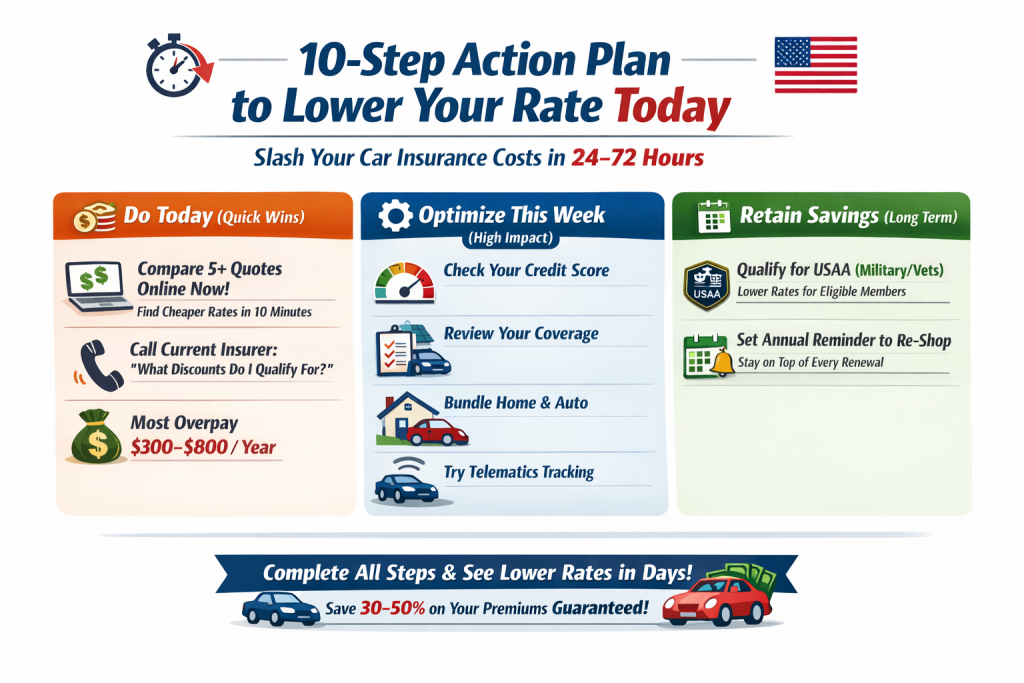
Don’t let this be another article you read and forget. Here are the exact steps — in order — from reading this to a lower bill:
- ☑ Go to Insurify, The Zebra, or Compare.com right now. Get quotes from 5+ companies using the exact same liability limits and deductible you have today. Takes 10–15 minutes.
- ☑ Call your current insurer and say: “What discounts am I currently receiving, and what discounts do I qualify for that I’m not getting?” Write down every answer.
- ☑ Pull your credit score (free at Credit Karma or AnnualCreditReport.com). If it’s below 670, a credit improvement plan will directly lower your insurance premiums within 6–12 months.
- ☑ Look up your car’s value on Kelley Blue Book (kbb.com). If it’s under $4,000–$5,000 and you own it outright, consider dropping collision and comprehensive coverage.
- ☑ Check your driving record (your state’s DMV website). Know what’s on it, when incidents age off, and whether anything has dropped off recently that you haven’t re-quoted for yet.
- ☑ Ask about telematics / usage-based insurance if you drive safely and under 10,000 miles/year. Even signing up earns a discount at most companies, before any driving behavior data comes in.
- ☑ Bundle your home or renters insurance with your auto policy if you haven’t already. This single move typically saves 11–24%.
- ☑ Review your deductible. If it’s $250 or $500 and you have $1,000+ in accessible savings, raising it to $1,000 can cut $150–$250 from your annual premium with no other changes.
- ☑ If you qualify for USAA (active military, veteran, or qualifying family member), get that quote first. Nothing in the market consistently prices lower for eligible drivers.
- ☑ Set a recurring 12-month reminder to re-shop before every renewal. Also set triggers: any time you move, buy a new car, get married, add or remove a driver, or pay off a loan — re-quote within 30 days.
💬 Real Result: One couple followed a process almost identical to this one and cut their annual auto premium by $2,680 — without changing a single detail of their coverage. They simply switched to a company that priced their profile more favorably. The only thing that changed was who they paid.
Frequently Asked Questions
What is the cheapest car insurance company in the US in 2026?
For eligible military members and veterans, USAA is the cheapest — averaging around $1,399/year for full coverage, which is 45% below the national average. For civilians, Travelers is the cheapest large national insurer at approximately $1,591–$1,665/year for full coverage, according to NerdWallet’s March 2026 analysis. GEICO is the cheapest for liability-only at around $41/month nationally.
How can I lower my car insurance immediately?
The fastest ways to lower your rate right now: (1) Get 3–5 competing quotes through a comparison site like Insurify or The Zebra and switch if you find a better deal. (2) Call your insurer and ask about every available discount, especially good driver, bundling, and low-mileage. (3) Raise your deductible if you have enough savings to support a higher out-of-pocket amount. Some insurers also allow you to add telematics discounts mid-policy.
How much does car insurance cost on average in 2026?
The national average is $208/month ($2,496/year) for full coverage, according to ValuePenguin’s 2026 State of Auto Insurance report. Minimum coverage averages $863/year. Rates vary widely by state — Vermont averages around $80/month while Nevada exceeds $300/month for full coverage.
Is it worth getting full coverage on an older car?
Generally not, once your car’s value drops below $4,000–$5,000 and you own it outright. A common rule of thumb: if your annual full coverage premium exceeds 10% of the car’s current market value, dropping to liability-only often makes financial sense. Always check Kelley Blue Book first.
Does my credit score really affect my car insurance rate?
Yes — significantly — in most U.S. states. Drivers with poor credit pay an average of 76% more than those with good credit for identical coverage. California, Hawaii, Massachusetts, and Michigan are exceptions where credit-based pricing is banned by law.
How often should I shop for car insurance?
At a minimum, once per year — before your renewal date. Also re-shop after any major life change: moving to a new address, buying a different car, getting married, adding or removing a driver, paying off a car loan, or when an accident or ticket ages off your driving record.
What is the cheapest type of car insurance?
Liability-only (state minimum) is the cheapest type. GEICO and Auto-Owners offer liability coverage starting around $34–$41/month nationally. However, this covers only damage you cause to others — not any damage to your own vehicle.
Can I get cheap car insurance with no deposit or down payment?
Some insurers market “no down payment” or “low deposit” policies, but most still require at least the first month’s premium upfront to activate coverage. Paying your full annual premium at once typically gets you the best total price — including a 5–10% discount at most insurers. For monthly plans, compare rates from State Farm, Progressive, and GEICO, which tend to have the most competitive monthly payment options.
What is the cheapest car insurance for a first-time driver?
Staying on a parent’s or family member’s policy is almost always the cheapest option for first-time and new drivers. For standalone policies, Progressive consistently prices lowest for drivers under 25 nationally. Completing a driver education course and maintaining good grades (for students) can cut the rate further by 5–25%.
Does car insurance go down after 25?
Yes, for most drivers. Age 25 is a common threshold where rates begin to decrease meaningfully. Rates typically reach their lowest point for drivers in their 40s–50s before gradually rising again around age 70 due to increased accident risk.
The Bottom Line: How to Find Cheap Car Insurance
There’s no magic trick. No secret company. No loophole.
The drivers who pay the least for car insurance do three things, consistently:
- They compare quotes — at least 3–5, with identical coverage, every single year.
- They ask about every discount — good driver, bundling, low mileage, telematics, pay-in-full. They stack as many as possible.
- They right-size their coverage — full coverage when it makes financial sense, liability-only when it doesn’t.
The national average is $208/month. Most drivers following the steps in this guide can do meaningfully better — without sacrificing the coverage they actually need when something goes wrong.
Start with a free comparison quote today. It takes 10 minutes, costs nothing, and the average savings for drivers who switch is $500–$1,100 per year. That’s real money back in your pocket — just for doing the math.






Leave a Reply