
You walked to your car. You saw it. Your stomach dropped. A scratch. Out of nowhere.
Here is the truth no workshop will tell you: 8 out of 10 car scratches can be removed at home in under 30 minutes, for less than the cost of a lunch. The other 20 percent need a professional — and this guide tells you exactly which is which, so you never waste time or money on the wrong fix.
What Your Car’s Paint Is Actually Made Of
Before you touch anything, understand this. Car paint is not one solid layer. It is a stack of four layers, each protecting the one below it.
Layer 1 — E-Coat: Sits directly on the bare metal. Prevents rust. You never want to reach this.
Layer 2 — Primer: Grey or reddish. Helps paint stick to metal. Also a rust barrier.
Layer 3 — Base Coat: The actual colour of your car — red, white, silver, etc.
Layer 4 — Clear Coat: The glossy transparent top layer, roughly 2 thousandths of an inch thick. This is what gets scratched most often.
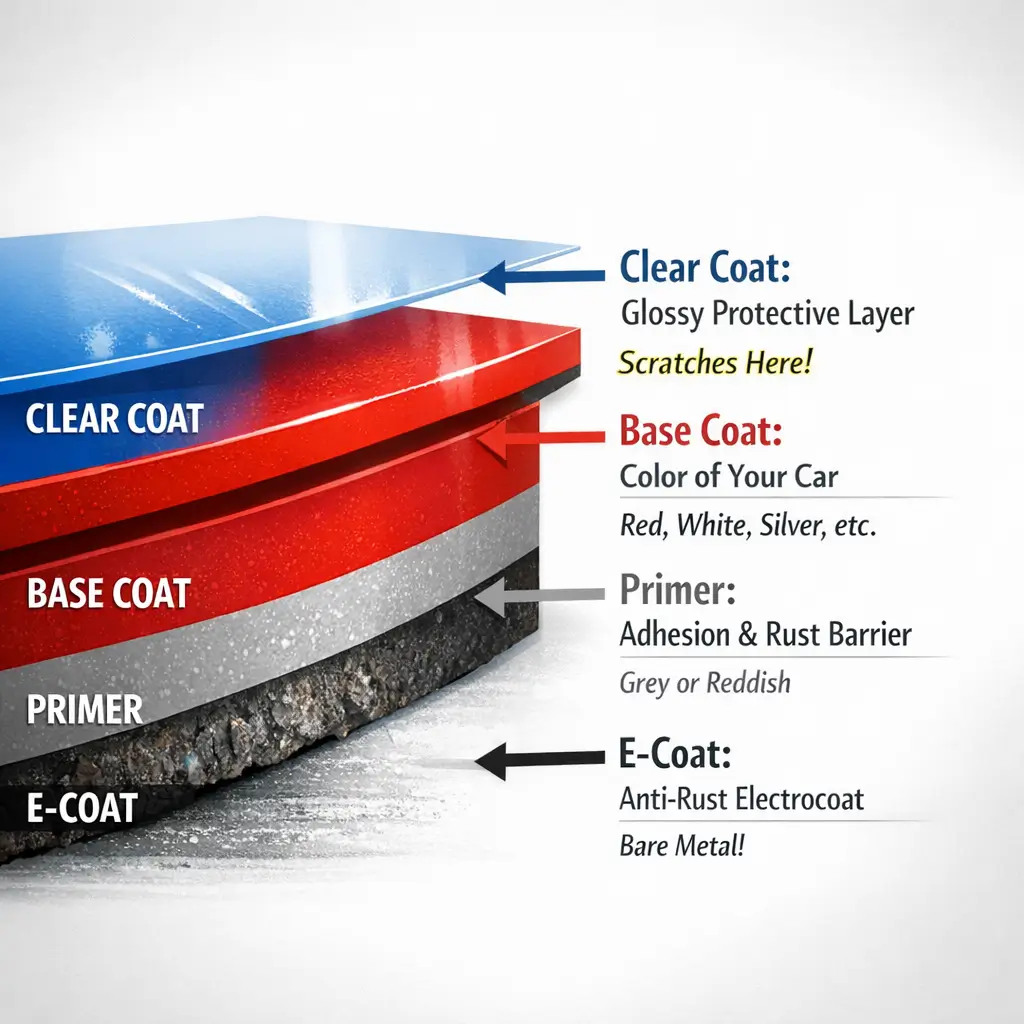
Key insight: Most everyday scratches only damage Layer 4. A polishing compound smooths the clear coat so light stops scattering off the rough edges — and the scratch disappears. Go deeper than Layer 4, and you need more than polish.
Step 1: Identify Your Scratch Type (60 Seconds)
Getting this wrong is the number one reason DIY repairs fail. Run all three checks before buying a single product.
The Fingernail Test (Most Reliable)
Run your fingernail ACROSS the scratch — not along it.
- Nail glides smoothly, no catch at all → Clear coat only. Easiest fix. Polish works perfectly.
- Nail catches slightly but does not drop in → Deeper clear coat, possibly reaching base coat. Polish first, then touch-up paint if needed.
- Nail drops into a groove → Base coat or primer exposed. Touch-up paint required.
- You see grey primer, reddish colour, or shiny bare metal → Deep scratch. Rust risk. Professional repair recommended.
The Water Test (Quick Backup)
- Spray water over the scratch — scratch almost disappears? Clear coat only.
- Scratch stays fully visible? Deeper damage present.
The Light Angle Test (What AAA Recommends)
Move your car under direct light. View the scratch from multiple angles. A scratch that disappears in certain light is almost always limited to the clear coat only. Scratches that remain visible from every angle have penetrated deeper.
Scratch Type Summary
| Scratch Type | How to Spot It | Nail Test Result | Fix Needed |
| Clear Coat | White or hazy line only | Nail glides smoothly | Polish compound |
| Base Coat | Your car colour visible at bottom | Nail catches slightly | Touch-up paint |
| Primer | Grey or reddish colour in groove | Nail drops into groove | Touch-up + primer |
| Metal/Deep | Shiny bare metal showing | Deep groove, metal visible | Body shop — urgent |
Step 2: Prepare the Surface (Never Skip This)
Dirt under your cloth acts like sandpaper. Skipping prep is how one scratch becomes three.
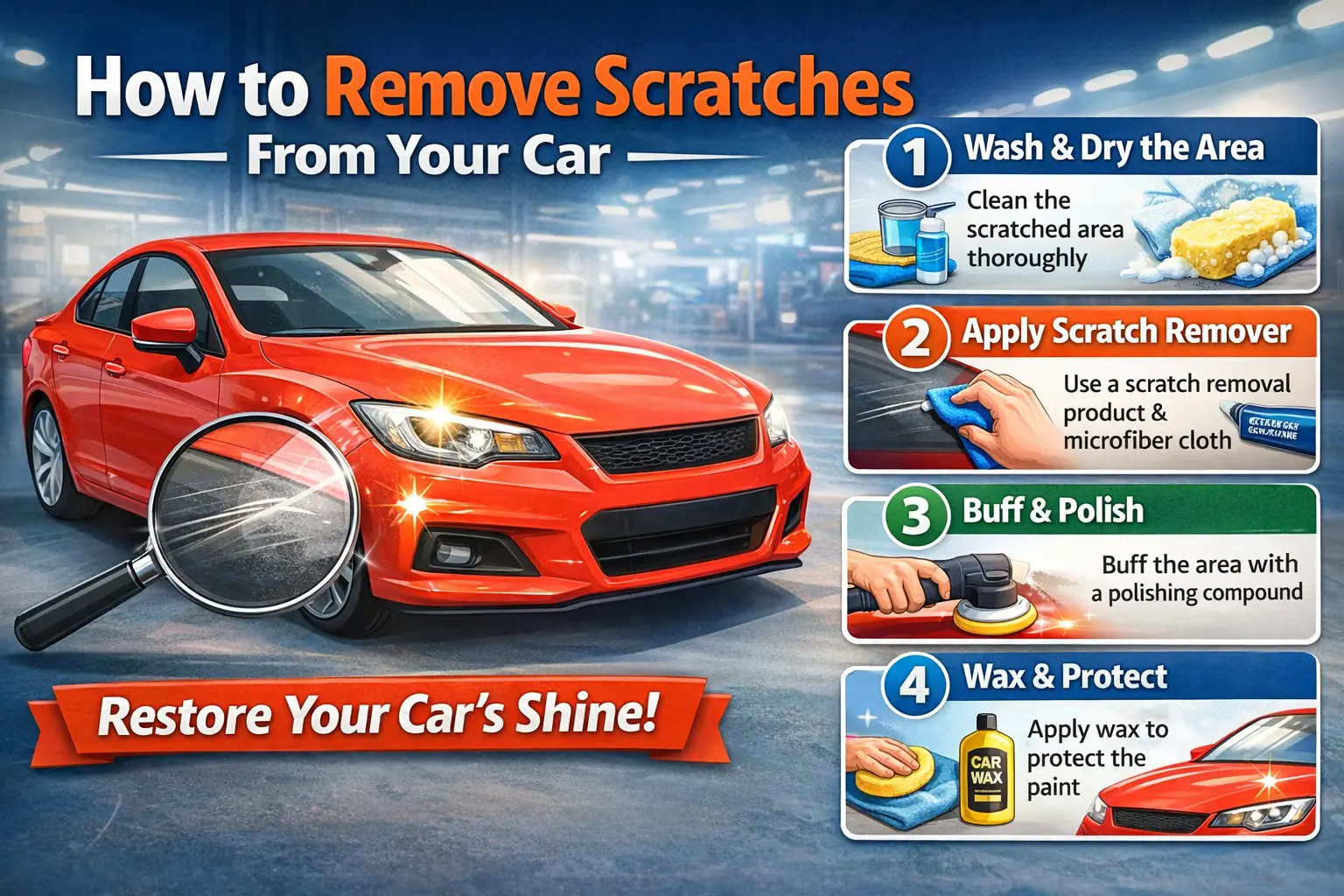
- Wash the area with car soap and water.
- Rinse fully. Dry with a clean microfiber cloth.
- Wipe with isopropyl alcohol to remove wax, oil, and residue.
- Move to shade. Heat makes products dry too fast and leaves uneven streaks.
Important: Use only microfiber cloths. Regular towels, sponges, and paper towels all scratch clear coat — even when they feel soft.
Pro Tip — Clay Bar Decontamination: Top competitors Chemical Guys and AAA both recommend using a detailing clay bar before polishing. Clay removes bonded contaminants — brake dust, tree sap, road tar — that washing alone cannot reach. Run your hand over clean paint. If it feels gritty or rough, clay first. If smooth, skip straight to polishing. Clay bars are available at any auto parts store for around Rs. 400 to Rs. 800.
Step 3: Choose Your Method and Fix the Scratch
Method 1 — Polishing Compound (Best for 80% of Scratches)
Best for: Clear coat scratches. Nail glides over it. White or hazy line only.
Success rate: 70–90% removal. Near 100% on fine swirl marks.
The compound is mildly abrasive. It removes a tiny amount of clear coat to level the surface around the scratch, making it invisible to light and to the eye.
Products that work well:
- Meguiar’s Scratch X 2.0 — great for hand application
- Chemical Guys VSS Scratch and Swirl Remover — beginner-friendly
- 3M Rubbing Compound — stronger, use carefully
- Turtle Wax Scratch Repair and Renew — easy to control
Steps:
- Apply a pea-sized amount to a microfiber cloth.
- Rub in small overlapping circles with moderate pressure.
- Work for 30 to 60 seconds directly on the scratch.
- Wipe residue with a clean cloth.
- Inspect. Repeat two to three times if needed.
- Finish with car wax — you have thinned the clear coat and it needs protection immediately.
For faster results: Use a dual-action (DA) polisher at around 1,200 rpm instead of hand rubbing. Gives more consistent results and is nearly impossible to burn through with.
Method 2 — Detailing Clay Bar (Before Polishing on Rough Paint)
Best for: Paint that feels gritty after washing. Use before any polish or compound work.
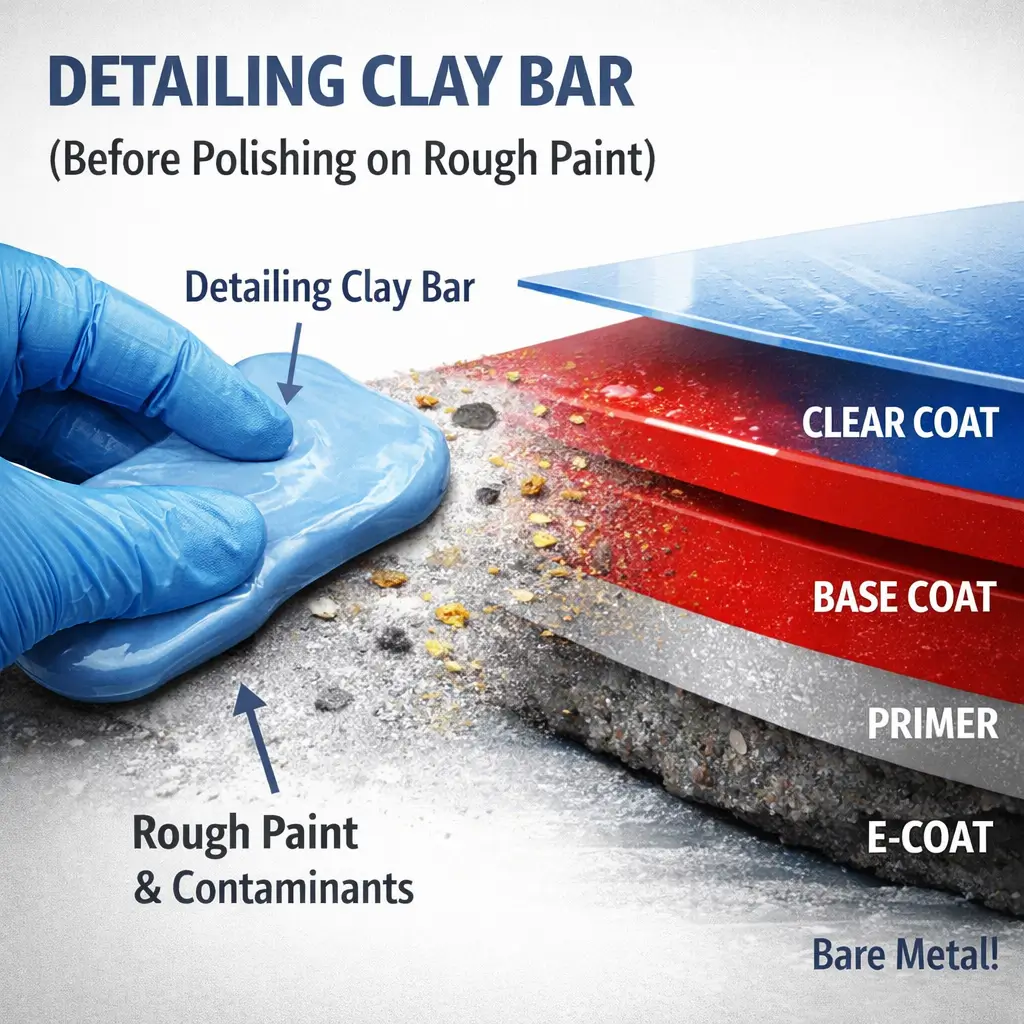
Important distinction: Clay bars do NOT remove scratches. They remove bonded contamination — brake dust, industrial fallout, tree sap, tar — from the surface of your clear coat. This is a deep clean before the actual repair.
Steps:
- Spray clay lubricant generously on a small section (about 2 x 2 feet).
- Break off one-third of the clay bar and knead it flat.
- Glide the clay back and forth in straight lines with light pressure.
- The clay will grab at first — keep going until it glides freely.
- Wipe the area clean with a microfiber cloth.
- Move to the next section. Never work dry — always keep the surface lubricated.
- If you drop the clay bar, throw it away immediately. Ground debris will scratch paint.
After claying: Run your hand over the paint. It should feel smooth as glass. Now proceed to polishing.
Method 3 — Touch-Up Paint (For Medium Scratches)
Best for: Scratches where your nail catches and you can see your car’s colour at the bottom.
Find your paint code first:
Open your driver’s door and look for a sticker on the door frame. Find ‘Colour Code’ or ‘Paint Code.’ Use that exact code to order matching paint online or at an auto parts store. Ordering by VIN number is even more accurate for older cars.
Steps:
- Clean and fully dry the area.
- If bare metal is visible: spray rust-inhibiting primer. Let dry 15–20 minutes.
- Apply touch-up paint in thin layers using the pen tip or a toothpick. Thin layers cure properly. Thick globs bubble and crack.
- Let each layer dry 10–15 minutes before the next coat.
- Build up layers until the groove is filled and sits slightly raised.
- Wet sand gently with 2000-grit sandpaper. Keep surface and sandpaper wet. Sand in straight lines — never circles. Stop when level.
- Wipe clean. Apply polishing compound to blend and smooth the area.
- Spray clear coat to seal and protect.
- Finish with car wax.
Do not skip wet sanding. Without it, the touch-up spot will appear raised and catch light differently than surrounding paint.
Method 4 — Toothpaste (5-Minute Emergency Fix Only)
Works only on very light surface marks. Toothpaste contains mild abrasive particles — the same science as polish but far weaker.
- Use white, non-gel toothpaste only. Not whitening formulas.
- Apply a small amount to a damp soft cloth.
- Rub gently in circular motions for one to two minutes.
- Rinse and dry. Repeat once if needed.
Honest warning: This reduces how visible a scratch looks — it does not fully repair it. For any scratch your nail catches on, use Method 1 or Method 3. Automotive expert Chris Pyle (JustAnswer) notes the grit is so fine it takes significant effort for even minor results.
Method 5 — Wet Sanding (Advanced, Stubborn Deep Clear Coat Only)
For scratches that polish alone cannot fix but haven’t reached the base coat. Warning: This removes more material than polish. Only attempt if you are comfortable with careful, patient detail work.
- Wet both the 2500 to 3000-grit sandpaper and the car surface.
- Sand in straight lines only — never circles — with very light pressure.
- Check progress every 20 seconds. Stop the moment the scratch levels.
- Stop immediately if you see primer colour appearing — go to a body shop.
- Follow with polishing compound to restore gloss.
- Finish with wax.
Method 6 — Clear Nail Polish (Bare Metal Protection Only)
Not a cosmetic fix. Apply clear nail polish over any scratch that has reached bare metal. It stops air and moisture from starting rust. Replace with a proper touch-up paint repair as soon as possible.
When to Stop and Call a Professional
DIY is not always the right answer. Go to a body shop if:
- Bare metal is visible — rust can begin within 48 hours in humid conditions
- The scratch is longer than 6 inches
- Damage spans two or more panels
- Your car has dark, metallic, or pearl paint — colour matching is extremely difficult without professional tools
- You tried DIY and the result looks worse than before
- The car is a luxury vehicle or resale value matters significantly
- You are not comfortable with wet sanding or power tools
2026 Repair Cost Estimate (India):
| Damage Level | Professional Cost (India) | DIY Cost |
| Light – clear coat polish | Rs. 800 – Rs. 2,500 per panel | Rs. 300 – Rs. 600 |
| Medium – touch-up paint | Rs. 3,000 – Rs. 8,000 | Rs. 800 – Rs. 1,500 |
| Deep – full panel repaint | Rs. 15,000 – Rs. 40,000+ | Not recommended |
Professional shops also offer a warranty. If the repair fades or peels, they fix it at no additional cost.
Mistakes That Make Scratches Worse
- Using WD-40 on a scratch — It hides the scratch temporarily with oil. Once it evaporates, the scratch returns fully. It also leaves residue that makes polishing harder.
- Using a Magic Eraser on car paint — Magic Erasers are micro-abrasive. They dull clear coat and create swirl marks that are harder to fix than the original scratch.
- Working in direct sunlight — Products dry too fast. You get uneven, streaky, patchy results. Always work in shade or a covered garage.
- Rubbing too hard with compound — Aggressive pressure generates heat. Heat burns through clear coat to the base coat — turning a minor fix into a full paint job.
- Skipping wax after polishing — You just thinned the clear coat. It is now more vulnerable to UV, water spots, and new scratches. Always wax after polishing.
- Using the same cloth for different tasks — One cloth for washing, one for polishing, one for waxing. Contaminated cloths carry abrasive particles onto fresh paint.
- Polishing over a dirty or gritty surface — Any dirt particle under your cloth becomes a cutting tool. Clean first, every single time.
- Using budget scratch kits from unknown brands — Cheap kits often use grit that is too coarse. They remove more paint than needed and leave visible marks.
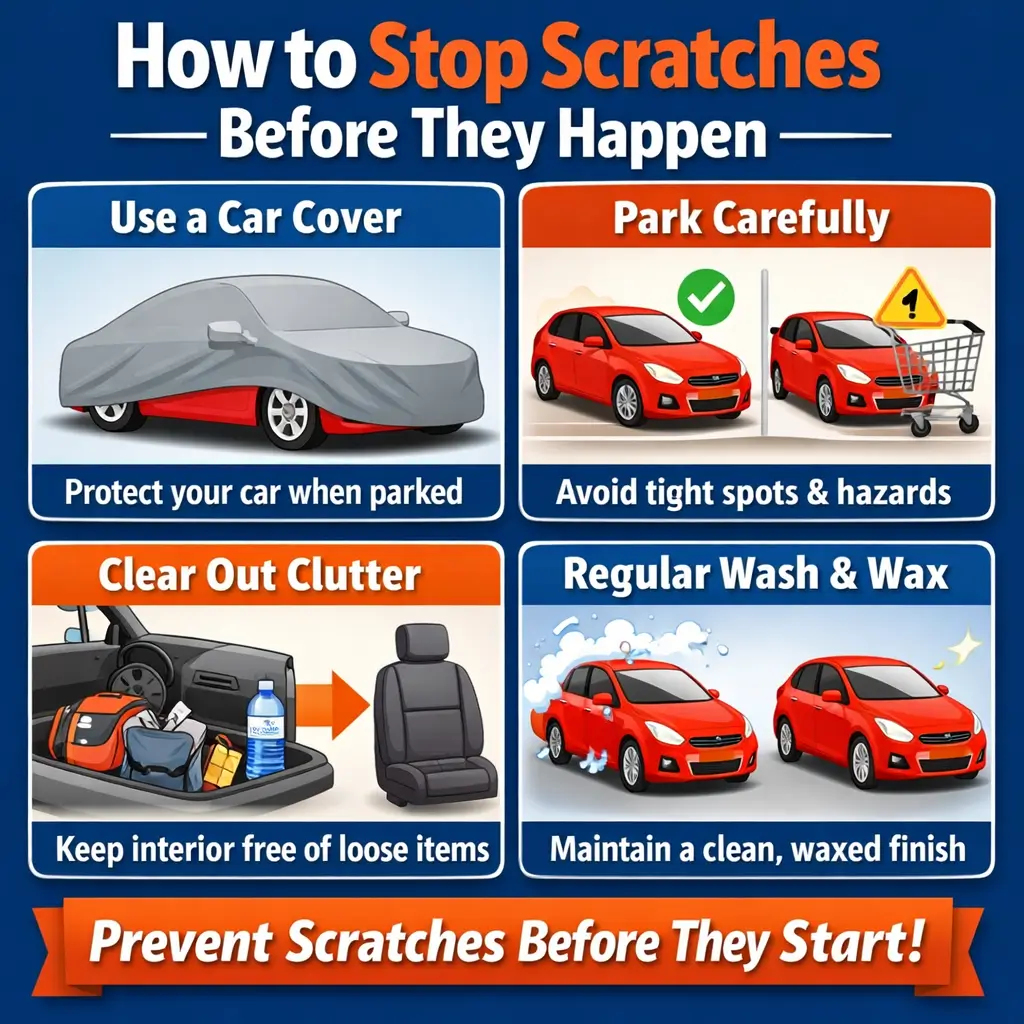
How to Stop Scratches Before They Happen
The best repair is the one you never have to do.
Park Smarter
- Park at the back of lots, away from shopping carts and other vehicles
- Avoid trees, bushes, and overhanging branches
- Never park next to vehicles with wide mirrors or open doors
Wash Correctly (Most Swirl Marks Come From Washing)
- Use the two-bucket method — one for soap, one for rinsing
- Rinse your wash mitt in the rinse bucket before every single pass
- Never drag a dry cloth across dry paint — always use water as lubricant
- Avoid automatic car washes with spinning brush rollers — they collect grit and create micro-scratches on every single wash
Remove Bird Droppings and Tree Sap Immediately
These etch into clear coat permanently if left for more than a few hours in direct sunlight. Rinse them off as soon as you notice them.
Protect the Paint
- Apply quality car wax every 3–4 months
- Use spray sealant monthly between wax coats
- Ceramic coating is a longer-lasting alternative — lasts 1–2 years
- Paint Protection Film (PPF) on hood edges, door handles, and mirrors provides a physical barrier against chips and scratches
- In winter, use a de-icer spray instead of an ice scraper — scrapers drag ice across paint and create deep clear coat scratches
Quick Decision Table — Find Your Fix
| What You See and Feel | Best Method | Time Needed |
| Nail glides. Hazy white line. | Polish compound | 15–20 min |
| Nail catches. Hazy/faint line. | Polish x3 passes | 25–35 min |
| Nail catches. Colour showing. | Touch-up paint | 1–2 hours |
| Nail drops in. Primer visible. | Touch-up + primer | 2–3 hours |
| Paint feels gritty after wash. | Clay bar first, then polish | 30–45 min |
| Bare metal showing. | Body shop — do not delay | N/A |
| Scratch over 6 inches. | Body shop | N/A |
| Multiple panels affected. | Body shop | N/A |
Frequently Asked Questions
Can I permanently remove a car scratch at home?
Yes, for clear coat and base coat scratches. Polish and touch-up paint are permanent repairs, not cover-ups. Deep scratches reaching primer or metal can also be permanently fixed at home but require careful colour matching.
Does WD-40 actually remove car scratches?
No. It fills the groove with oil temporarily. Once the oil evaporates, the scratch returns fully. It also leaves residue that makes polishing harder. Do not use it on paint scratches.
How long do I have before a deep scratch causes rust?
Rust can begin within 48–72 hours on bare metal, especially in humid or coastal climates. Apply clear nail polish over exposed metal immediately to seal it while you arrange proper repair.
Will car insurance cover scratch repair?
Usually only if caused by another vehicle in a documented accident, or under comprehensive cover for vandalism. Most small parking lot scratches fall below the deductible. Check whether filing a claim will raise your premium first.
Can I fix scratches on a black or dark-coloured car at home?
Yes, but dark cars show swirl marks and streaks much more than light-coloured cars. Use a finer polish rather than aggressive compound. Work in shade only. For any scratch requiring colour matching, professional repair is strongly recommended.
What grit sandpaper should I use?
Start no coarser than 2000-grit for DIY work. For clear coat wet sanding, use 2500 to 3000-grit. Do not use 1000-grit at home — it removes paint too quickly and is difficult to control.
What is the difference between rubbing compound and polish?
Compound is more abrasive — use it for heavier scratches and swirl marks. Polish is finer — use it for light correction and restoring shine after compounding. Many one-step products combine both and work fine for home use.
Is a clay bar the same as a scratch remover?
No. A clay bar removes bonded surface contamination — brake dust, tar, industrial fallout. It does not remove scratches. Polish and compound remove scratches. Use clay first if paint feels rough, then follow with polish.
Are scratch remover pens any good?
Scratch repair pens filled with clear coat resin work well on very fine clear coat scratches. They are not effective on scratches that catch your nail or show any colour at the bottom.
What causes most car scratches?
Automatic car wash brush rollers, other vehicle doors in parking lots, keys and coins brushing doors, shopping carts, tree branches, ice scrapers in winter, and road debris kicked up at speed. Bird droppings and tree sap left too long also etch into clear coat permanently.
Tools and Products Checklist by Scratch Level
For Clear Coat Scratches (Rs. 300 to Rs. 600 total)
- Polishing or scratch remover compound
- Two to three microfiber cloths
- Car wax
For Medium Scratches Reaching Base Coat (Rs. 800 to Rs. 1,500 total)
- Everything in the clear coat kit above
- Colour-matched touch-up paint pen
- Clear coat spray
- 2000-grit wet sandpaper
- Isopropyl alcohol for surface prep
For Deep Scratches With Bare Metal (Rs. 1,200 to Rs. 2,000 total)
- Everything in the medium scratch kit above
- Rust-inhibiting primer spray
- Rubbing compound (heavier than polish)
- Strongly consider professional repair at this level
Always Avoid
- Regular household sponges anywhere near paint
- Paper towels on any painted surface
- General multi-purpose cleaning sprays on paint
- Any product not specifically labelled for automotive paint use
The 30-Second Summary
| What Your Nail Does | Your Fix |
| Glides smoothly over it | Polish compound — done in 20 minutes |
| Catches slightly | Polish first, then touch-up paint if needed |
| Drops into the groove | Touch-up paint and clear coat |
| Deep groove, metal visible | Professional body shop — do not wait |
Golden rule: Whatever method you use — always clean first, always work in shade, always finish with wax.
What to Do Right Now
- Go to your car and run the fingernail test right now.
- Match your result to the decision table above.
- Buy only what you need from the checklist above.
- Work in shade. Clean first. Finish with wax.
Still unsure which method fits your scratch? Take a clear photo in direct sunlight from two different angles. Sunlight reveals the true depth immediately and makes the right fix obvious.







Leave a Reply