
Nobody wakes up wanting an SR-22. You get one because something went wrong — a DUI, a lapse in coverage, too many tickets. Now you’re staring at insurance quotes that make your stomach drop. The good news? SR-22 insurance isn’t as complicated (or as permanently expensive) as it feels right now. This guide breaks down exactly what an SR-22 is, what you’ll actually pay in 2026, and how to keep costs as low as possible.
What Exactly Is an SR-22?
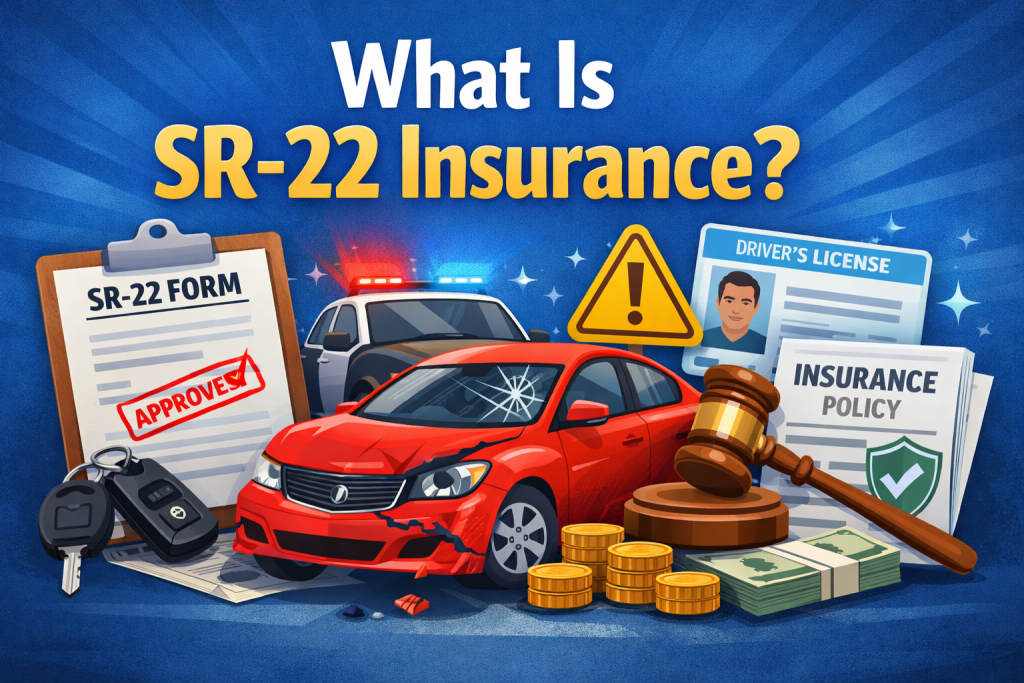
Here’s the first thing most people get wrong: SR-22 is not a type of insurance.
It’s a one-page form. That’s it. Your insurance company files this form with your state’s DMV to prove you carry at least the minimum required liability coverage. Think of it as a permission slip that says, “Yes, this driver has real insurance. We vouch for them.”
The DMV or a court orders you to get one after serious driving violations. Once your insurer files it, the state monitors your coverage status. If your policy lapses or gets canceled, your insurer has to report that too — and your license gets suspended again.
Quick facts about SR-22 filings:
- It’s a certificate of financial responsibility, not a separate policy
- Your insurance company files it directly with the state
- Most states require it for 3 years (some require 1–5 years)
- Not every insurance company offers SR-22 filings
- It follows you even if you move to a different state
Why Would You Need an SR-22?
Courts and state DMVs don’t hand these out for minor fender benders. An SR-22 usually comes after a serious violation that flags you as a high-risk driver.
The most common reasons include:
- DUI or DWI conviction — This is the #1 trigger in almost every state
- Driving without insurance — Getting caught uninsured or causing an accident without coverage
- Reckless driving — Especially when it endangered others or caused damage
- Driving on a suspended or revoked license — Continuing to drive after the state pulled your privileges
- Too many points on your record — Racking up multiple violations in a short window
- At-fault accident while uninsured — You caused a crash and had no coverage to pay for it
- Unpaid court-ordered child support — Yes, this can trigger it in some states
Here’s the bottom line. If the state considers you a risk on the road, an SR-22 is how they keep tabs on you.
How Much Does SR-22 Insurance Cost in 2026?
Let’s get to the numbers everyone wants to know.
There are actually two separate costs baked into an SR-22 requirement. Most people only know about one.
Cost #1: The SR-22 Filing Fee
This is the small one. Your insurance company charges a one-time fee to file the SR-22 paperwork with the state.
- Typical range: $15 to $50
- Average cost: About $25
- Frequency: One-time (or once per policy term)
This fee is almost a rounding error compared to what comes next.
Cost #2: Your Higher Insurance Premium
This is where the real money goes. Because you now have a major violation on your record, insurers classify you as high-risk. That label drives your premium way up.
Here’s what drivers are actually paying in 2026:
| Situation | Monthly Cost | Annual Cost |
|---|---|---|
| SR-22 after DUI (liability only) | $150–$470 | $1,800–$5,600 |
| SR-22 after DUI (full coverage) | $213–$550+ | $2,500–$6,600+ |
| SR-22 after at-fault accident | ~$251/month avg. | ~$3,012/year avg. |
| Non-owner SR-22 (no car) | $30–$150 | $360–$1,800 |
The average driver with one DUI conviction pays roughly $348 per month — about $190 more than a typical driver without violations, according to 2026 industry data.
Key point: The premium increase comes from the violation on your record, not from the SR-22 form itself. The SR-22 is just the state watching you. The DUI, the reckless driving charge, or the lapse in coverage is what’s actually making your rates spike.
SR-22 Cost by State: Where You Live Changes Everything
Your zip code is one of the biggest factors in what you’ll pay. A driver with the same age, car, and violation can pay thousands more per year simply because they live in a different state.
Most expensive states for SR-22 insurance:
- Michigan — No-fault rules and personal injury protection requirements push costs sky-high
- California — High accident rates and strict regulations
- Florida — Frequent claims and expensive repairs (uses FR-44 for DUI, not SR-22)
- Louisiana — High claim frequency across the board
- South Carolina — Average around $4,400/year for SR-22 drivers
Most affordable states for SR-22 insurance:
- North Dakota — Lower traffic density and fewer high-risk drivers
- Iowa — Fewer expensive injury claims
- Vermont — Generally lower insurance costs
- Maine — Insurers handle fewer large claims here
States that DON’T use SR-22 at all:
Eight states skip the SR-22 form entirely and verify coverage through other methods:
- Delaware
- Kentucky
- Minnesota
- New Mexico
- New York
- North Carolina
- Oklahoma
- Pennsylvania
Two states — Florida and Virginia — use a stricter form called the FR-44 instead of the SR-22 for DUI convictions. The FR-44 requires much higher liability limits. In Florida, for example, a DUI conviction means you need $100,000/$300,000/$50,000 in liability coverage — far above normal minimums.
Even if your state doesn’t require SR-22, you still need to carry minimum liability insurance. And if you got your SR-22 requirement in one state and move to a non-SR-22 state, the requirement follows you until you complete the full mandated period.
What Factors Affect Your SR-22 Premium?
Not everyone with an SR-22 pays the same amount. Here’s what moves the needle:
1. The violation itself A DUI hits harder than a lapse in coverage. A hit-and-run is the most expensive — averaging around $188/month for minimum coverage alone. Multiple violations or a repeat DUI can push premiums to the absolute ceiling.
2. Your state State regulations, minimum coverage requirements, local claim rates, and accident frequency all play a role. The same driver can get wildly different quotes depending on geography.
3. Your age Drivers under 25 already pay higher premiums. Stack an SR-22 on top of that young-driver surcharge and the numbers get steep fast.
4. Your overall driving history First-time offense with an otherwise clean record? You’ll pay less than someone with multiple tickets, accidents, or a previous SR-22.
5. Your vehicle Sports cars, luxury cars, and vehicles with poor safety ratings cost more to insure. This baseline cost amplifies once the SR-22 surcharge kicks in.
6. Your insurance company This is the factor you can actually control. Two companies looking at the same driver can reach completely different conclusions about risk. One might quote $180/month while another quotes $280/month for the same coverage. The spread is massive.
Cheapest SR-22 Insurance Companies in 2026
Not all insurers treat high-risk drivers the same way. Based on 2026 rate analysis across multiple states, here are the companies consistently offering the lowest SR-22 premiums:
| Company | Avg. Monthly Cost (Full Coverage, Post-DUI) | Notes |
|---|---|---|
| Country Financial | ~$213 | Cheapest overall for DUI drivers |
| USAA | ~$221 | Military members and families only |
| State Farm | ~$227 | Best widely available option |
| Erie | ~$252 | Cheapest minimum coverage ($133/mo) |
| Progressive | ~$309 | Good nationwide availability |
| GEICO | ~$309 | Strong online quote process |
Important notes:
- USAA is only available to active military, veterans, and their families
- Erie and Country Financial aren’t available in every state
- State Farm stands out for offering a safe driving program (Drive Safe & Save) that can cut premiums up to 30%
- Specialty high-risk insurers like Dairyland, SafeAuto, The General, and Acceptance Insurance also cater to SR-22 drivers and sometimes beat mainstream carriers on price
The takeaway: Get quotes from at least 3–5 different companies. This single step can save you hundreds of dollars per year.
Non-Owner SR-22 Insurance: The Cheaper Option
Don’t own a car but still need an SR-22 to reinstate your license? A non-owner SR-22 policy is your best friend.
This type of policy covers your liability when you drive someone else’s car or a rental. Because there’s no physical vehicle being insured (no collision or comprehensive coverage needed), costs drop dramatically.
What non-owner SR-22 typically costs in 2026:
- Clean record needing reinstatement: Around $30–$50/month
- After a DUI: Around $50–$150/month
- Average range nationally: $30–$85/month
That’s roughly 40–60% cheaper than an owner-based SR-22 policy.
USAA offers the lowest non-owner SR-22 rates at about $28/month, but again, that’s limited to military-connected individuals. For everyone else, companies like Dairyland, SafeAuto, and The General tend to offer competitive non-owner rates and can usually file same-day.
How Long Do You Need to Keep an SR-22?
The clock starts when you file — and it doesn’t stop until you’ve completed the full required period without any lapses.
Typical SR-22 filing periods by state:
- 1 year: Connecticut, North Dakota
- 2 years: Texas, Iowa
- 2–3 years: Missouri
- 3 years: 26 states (the most common requirement)
- 3–5 years: Alabama, Arkansas, Indiana, Ohio, Tennessee
- 1–5 years: Kansas, Massachusetts (varies by offense)
- 3–20 years: Alaska (increases with each subsequent offense)
Here’s the critical part: any lapse in coverage restarts your clock.
If your insurance gets canceled, lapses, or you miss a payment during your SR-22 period, your insurer must notify the DMV immediately. Your license gets suspended again. And in many states, your entire SR-22 filing period starts over from scratch.
Set up automatic payments. Don’t let a missed $200 payment cost you three more years of elevated premiums.
7 Ways to Lower Your SR-22 Insurance Costs
You can’t avoid the SR-22, but you can shrink the bill. Here are practical strategies that actually work:
1. Compare at least 3–5 quotes This is the single most effective move. Rate differences between companies for the same driver can be $100+/month. Don’t skip this step.
2. Take a defensive driving course Many insurers offer discounts for completing a state-approved course. Some states also reduce points on your record, which further lowers premiums.
3. Raise your deductible If you’re carrying full coverage, bumping your deductible from $500 to $1,000 can lower your monthly payment meaningfully.
4. Drive an older, cheaper car Expensive vehicles and sports cars cost more to insure. A reliable but modest car keeps your base rate low.
5. Bundle your policies If you have renters or homeowners insurance, bundling with the same company often unlocks a discount. State Farm, for example, offers significant bundling savings.
6. Maintain a clean record going forward Every month without a ticket or accident works in your favor. Some insurers re-evaluate risk annually. A clean stretch can trigger rate reductions before your SR-22 period ends.
7. Ask about usage-based programs Programs like State Farm’s Drive Safe & Save or Progressive’s Snapshot track your driving habits. Good driving behavior can earn discounts up to 30%.
What Happens When Your SR-22 Period Ends?
Your SR-22 doesn’t automatically disappear when the filing period is over. You need to take action:
- Contact your state’s DMV to confirm your SR-22 requirement has been fulfilled
- Call your insurance company and ask them to remove the SR-22 filing from your policy
- Shop for new quotes — once the SR-22 is removed, you may qualify for significantly lower rates
Some drivers see their premiums drop immediately. Others see a gradual decrease over the next 1–2 years as the violation ages off their record. Either way, the day your SR-22 period ends is the day you should start shopping around aggressively.
SR-22 vs. FR-44: What’s the Difference?
If you live in Florida or Virginia and got a DUI, you won’t get an SR-22. You’ll get an FR-44 instead. Same concept, bigger commitment.
| Feature | SR-22 | FR-44 |
|---|---|---|
| What it proves | You carry state minimum liability coverage | You carry significantly higher liability coverage |
| States that use it | ~40 states + D.C. | Florida and Virginia only |
| Typical trigger | Various violations | DUI/DWI convictions specifically |
| Coverage requirements | State minimums | Much higher than minimums |
| Duration | Typically 3 years | 3 years |
In Florida, an FR-44 requires $100,000 per person / $300,000 per accident in bodily injury coverage and $50,000 in property damage. Compare that to Florida’s normal minimum of just $10,000 for bodily injury. That’s a 10x increase in required coverage — and it comes with premiums to match.
Frequently Asked Questions
How much does an SR-22 cost per month? Most drivers pay between $150 and $400/month in 2026 for liability-only coverage. The SR-22 filing fee itself is just $15–$50 one time. The real expense is the higher premium from your violation.
Can I get SR-22 insurance online? Yes. Most major insurers and high-risk specialists let you get quotes, purchase a policy, and file your SR-22 electronically — often same-day.
Does SR-22 insurance cover my car? Not by itself. The SR-22 only certifies you have liability coverage, which pays for other people’s injuries and property damage if you cause an accident. You’d need to add comprehensive and collision coverage separately to protect your own vehicle.
What happens if I let my SR-22 lapse? Your insurer reports the lapse to the DMV. Your license gets suspended. Your SR-22 filing period may restart from zero. Don’t let this happen.
Can I switch insurance companies while I have an SR-22? Yes, but there can’t be any gap in coverage. Get the new policy active and the new SR-22 filed before canceling the old one. Overlap by a few days to be safe.
Do all insurance companies offer SR-22 filings? No. Some major carriers won’t file SR-22s in certain states or refuse high-risk drivers entirely. If your current insurer won’t file, you’ll need to switch to one that does.
Bottom Line
An SR-22 feels like a punishment — and financially, it kind of is. But it’s temporary. Most drivers carry it for 3 years and move on.
The smartest thing you can do right now is compare quotes from multiple insurance companies. The difference between the cheapest and most expensive option for the exact same coverage can be $1,000+ per year. That’s money you keep just by shopping around.
Stay current on payments. Don’t let your policy lapse. Drive clean. And when your SR-22 period ends, shop for new rates immediately. The worst part of this is already behind you.








Leave a Reply