
You just got hit. Your hands are shaking. Your mind is racing. And the clock is already ticking on your legal rights.
Every year, roughly 6 million car accidents happen across the United States. In 2025 alone, an estimated 36,640 people died on American roads — and millions more walked away with injuries, wrecked cars, and zero idea what to do next.
This guide walks you through the exact steps to take after a car accident — from the moment of impact to the day you get paid. No legal jargon. No fluff. Just a clear, honest roadmap built for real people dealing with real crashes in 2026.
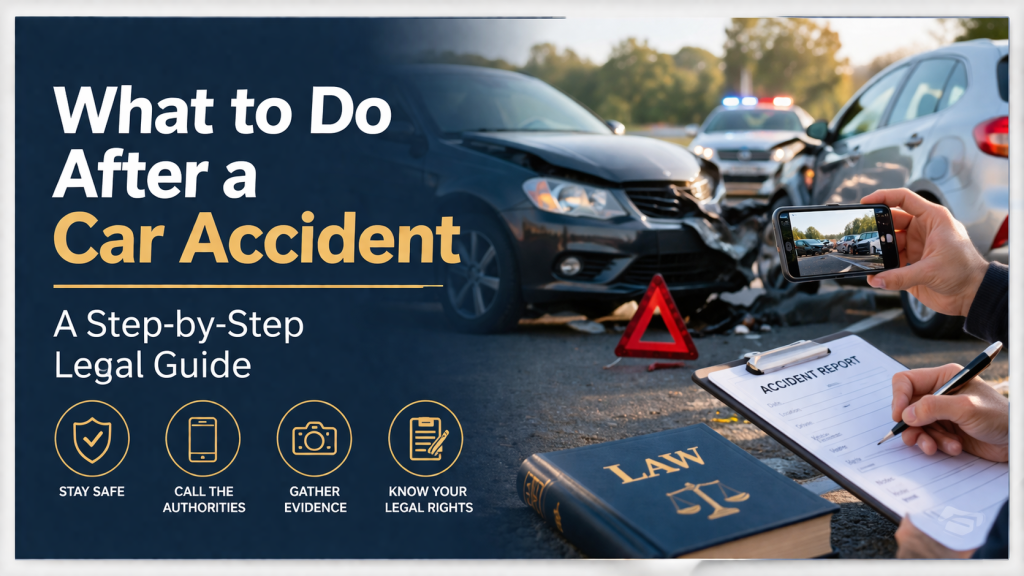
Step 1: Stop. Breathe. Check for Injuries.
This sounds obvious. But panic makes people do strange things.
Pull over if you can. Turn on your hazard lights. Check yourself, your passengers, and anyone else involved. If someone is hurt — even a little — call 911 immediately.
Here’s what matters most right now:
- Do NOT leave the scene. In every U.S. state, leaving the scene of an accident is illegal — especially if someone is hurt. It can turn a fender-bender into a felony.
- Do NOT move seriously injured people unless there’s immediate danger like fire or oncoming traffic.
- Do call 911 even for “minor” crashes. A police report is one of the strongest pieces of evidence you can have later.
Your health comes first. Everything else — the insurance, the blame, the dented bumper — can wait 10 minutes.
Step 2: Move to Safety (If You Can)
If your car still drives and nobody is seriously hurt, move it to the shoulder or a parking lot. Sitting in the middle of the road creates a second accident waiting to happen.
Turn on hazard lights. Set up cones or triangles if you have them. At night, use your phone flashlight to make yourself visible.
Quick safety checklist:
- Move vehicles out of traffic lanes
- Keep your seatbelt on until you’re in a safe spot
- Stay away from moving traffic
- Never stand behind or between vehicles on a highway
Step 3: Call 911 and Get a Police Report
This step is non-negotiable. Even if the other driver begs you to “just handle it between ourselves.”
Here’s why the police report matters so much:
- It documents who was at the scene, what happened, and when
- Officers note road conditions, witness statements, and sometimes fault
- Insurance companies treat police reports as primary evidence
- Without one, it becomes your word against theirs
When the officer arrives, stick to facts. Say what happened. Don’t guess. Don’t admit fault. Don’t say “I’m sorry” — insurance adjusters can twist that into an admission later.
Pro tip: Ask the officer for the report number before they leave. You’ll need it to file your insurance claim.
Step 4: Exchange Information (The Right Way)
While you’re waiting for police — or right after the report is filed — swap details with the other driver. Be polite but focused.
Get these details from every driver involved:
- Full name and phone number
- Driver’s license number
- Insurance company and policy number
- License plate number
- Car make, model, and color
Also grab contact info from any witnesses. These people vanish fast. A witness who saw the other driver run a red light could be worth thousands to your case.
What NOT to do during this step:
- Don’t argue about who caused the accident
- Don’t discuss your injuries in detail with the other driver
- Don’t sign anything at the scene
- Don’t agree to skip the insurance process
Step 5: Document Everything Like Your Case Depends on It (Because It Does)
Your phone is your best legal tool right now. Pull it out and start recording evidence.
Take photos and videos of:
- All vehicle damage — every angle, close-up and wide shots
- The full accident scene — road markings, traffic signals, signs, intersections
- Skid marks, debris, and broken glass on the road
- Your injuries — bruises, cuts, swelling (even if they look minor)
- The other driver’s license plate and insurance card
- Weather and lighting conditions
Write down your own notes while details are fresh. What lane were you in? What speed were you going? What did you see before impact? These details fade fast — and adjusters will use fuzzy memory against you.
Step 6: Get Medical Attention — Even If You Feel “Fine”
This is where most people mess up their entire case.
Adrenaline masks pain. Whiplash, concussions, and internal bleeding often don’t show symptoms for hours — sometimes days. If you skip the doctor and symptoms appear later, the insurance company will argue your injuries aren’t from the crash.
Go to a doctor or urgent care within 24 hours. Period.
Here’s what your medical visit does for your case:
- Creates an official medical record linking your injuries to the crash
- Establishes a treatment timeline that strengthens your claim
- Catches hidden injuries like soft tissue damage, concussions, or spinal issues before they get worse
Keep every receipt. Every bill. Every prescription. This paper trail becomes the backbone of your settlement.
Step 7: Notify Your Insurance Company
Report the accident to your insurance company within 24 to 72 hours. Most policies require “prompt notification,” and waiting too long can give them a reason to deny coverage.
When you call, keep it simple:
- Give the date, time, and location of the crash
- Share the police report number
- Provide the other driver’s information
- Describe what happened in basic terms
Critical warning: Do not give a recorded statement to the other driver’s insurance company without talking to a lawyer first. Their adjuster is not your friend. They’re trained to ask questions that reduce your payout.
Step 8: Understand the Insurance Adjuster’s Playbook
Insurance companies are businesses. Their goal is to pay you as little as possible. Knowing their tactics puts you in control.
Watch out for these common moves:
- The quick lowball offer. They call within days, offer a fast check, and hope you’ll take it before you know the full cost of your injuries. Most early offers are far below what claims are actually worth.
- Recorded statement traps. They ask you to describe the accident on tape, then pick apart your words to find contradictions.
- Social media surveillance. If you post a photo of yourself smiling at a family dinner, they may argue you’re not really hurt. Yes, this happens all the time.
- Blaming pre-existing conditions. If you had a prior back problem, they’ll say the accident didn’t cause your pain — your old injury did.
The bottom line: Be careful with what you say, what you post, and what you sign. When in doubt, talk to a lawyer before responding.
Step 9: Know When You Need a Lawyer
Not every fender-bender needs an attorney. But many crashes do — especially when money and injuries are involved.
You should strongly consider hiring a car accident lawyer if:
- You were seriously injured (broken bones, surgery, concussion, hospitalization)
- The other driver’s insurance is denying fault or offering a lowball settlement
- Multiple vehicles or drivers are involved
- A commercial truck, rideshare, or government vehicle caused the crash
- The other driver was uninsured or underinsured
- Someone died in the accident
Here’s a stat that gets people’s attention: accident victims who hire lawyers receive settlements that are, on average, 3.5 times higher than those who go it alone. Most personal injury attorneys work on contingency — meaning you pay nothing upfront and they only get paid if you win.
Step 10: Track Your Losses and Build Your Case File
From the moment the crash happens, start building a folder — physical or digital — with everything related to the accident.
Your case file should include:
- Police report
- Medical records and bills
- Photos and videos from the scene
- Insurance correspondence (emails, letters, claim numbers)
- Pay stubs showing lost wages
- Receipts for any accident-related expenses (rental cars, medication, physical therapy)
- A personal injury journal where you write how your injuries affect daily life
That journal matters more than you think. Describing how you can’t pick up your kid, or how you wake up in pain every night, puts a human face on your claim. Judges, juries, and even adjusters respond to real stories — not just numbers on a spreadsheet.
How Much Is Your Car Accident Claim Actually Worth?
Every case is different. But here’s a realistic look at where settlements typically land in 2026:
- Minor injuries (whiplash, sprains, soft tissue): $3,000 – $25,000
- Moderate injuries (broken bones, concussions): $25,000 – $100,000
- Severe injuries (spinal cord damage, TBI, surgery): $100,000 – $1,000,000+
- Catastrophic or wrongful death cases: $500,000 – $10,000,000+
- Property damage only (no injuries): $500 – $25,000
The average injury settlement in the U.S. sits around $15,000 to $30,000 for moderate cases. But that number jumps dramatically with serious injuries, clear liability, and proper documentation.
Settlement values depend on:
- How badly you were hurt
- How much your medical care costs (now and in the future)
- How much income you lost
- Who was at fault (and how clearly that can be proven)
- The at-fault driver’s insurance policy limits
- What state you’re in and its fault rules
At-Fault vs. No-Fault States: Why It Matters
Where your accident happens changes how you get paid.
At-fault states (like Texas, California, and Florida) mean the driver who caused the crash is responsible for paying damages. You file a claim against their insurance. If they don’t pay fairly, you can sue.
No-fault states (like Michigan, New Jersey, and New York) require you to file with your own insurance first — regardless of who caused the crash. You can only sue the other driver if your injuries pass a certain “serious injury” threshold.
Comparative negligence also plays a role. In most states, if you were partly at fault, your settlement gets reduced by your percentage of blame. Some states (like Alabama and North Carolina) follow a harsher rule — if you’re even 1% at fault, you get nothing.
Know your state’s rules. They directly impact how much money you can recover.
Watch the Clock: Statute of Limitations by State
Every state gives you a deadline to file a lawsuit after a car accident. Miss it, and your case is dead — no matter how strong it is.
Most states set the deadline at 2 to 3 years for personal injury claims. But some are shorter:
- Kentucky, Louisiana, Tennessee: 1 year
- Texas, California, Florida: 2 years
- New York, Illinois, Ohio: 3 years
Property damage claims sometimes have a different (and slightly longer) deadline.
Don’t wait until the last minute. Evidence disappears. Witnesses forget. Insurance companies get less cooperative as time drags on. The sooner you start, the stronger your position.
5 Mistakes That Kill Car Accident Claims
Avoid these traps. Each one costs real people real money every single day.
1. Saying “I’m fine” at the scene. Adrenaline lies. Many injuries don’t surface for days. Always get checked out.
2. Skipping the police report. Without an official record, the other driver can change their story. And they often do.
3. Posting on social media. That gym selfie two weeks after the crash? The insurance company’s lawyer already screenshotted it. Go dark on socials until your case is settled.
4. Accepting the first settlement offer. The first offer is almost never the best offer. It’s designed to close your case cheap and fast.
5. Waiting too long to call a lawyer. Evidence fades. Deadlines pass. The best time to talk to a lawyer is within the first week.
What Happens Next: The Claims Timeline
Knowing what to expect reduces stress and helps you make smarter decisions.
- Days 1–7: Focus on safety, medical care, police report, and evidence gathering. Notify your insurance company. Consult a lawyer if injuries are serious.
- Weeks 1–12: Your attorney investigates, gathers evidence, and communicates with insurance. You continue treatment.
- Months 3–12: Reach Maximum Medical Improvement (MMI) — the point where your doctors say you’ve recovered as much as you will. Now your full damages can be calculated.
- Months 6–18: Your lawyer sends a demand letter to the at-fault party’s insurance. Negotiations begin.
- Months 12–24+: If negotiations fail, your attorney files a lawsuit. Most cases settle before trial, but preparation matters.
Some claims resolve in weeks. Others take over a year. The timeline depends on injury severity, dispute complexity, and how hard the insurance company fights.
Your Car Accident Checklist (Save This)
Print this. Screenshot it. Keep it in your glove box.
- [ ] Check for injuries and call 911
- [ ] Move to safety and turn on hazard lights
- [ ] Wait for police and get a report number
- [ ] Exchange info with the other driver
- [ ] Get witness names and contact info
- [ ] Photograph everything — damage, scene, injuries
- [ ] See a doctor within 24 hours
- [ ] Notify your insurance company
- [ ] Do NOT give a recorded statement to the other driver’s insurer
- [ ] Do NOT post about the accident on social media
- [ ] Start a case file with all documents and receipts
- [ ] Consult a car accident lawyer if injuries are involved
Final Thought
A car accident is one of those moments that splits your life into “before” and “after.” The shock fades. The bruises heal. But the financial damage? That can follow you for years — unless you handle the legal side correctly from day one.
You now have the exact steps. Follow them. Protect yourself. And don’t let an insurance company’s speed-dial settlement cheat you out of what you actually deserve.
If you’ve been in a crash and aren’t sure what to do next, talk to a licensed personal injury attorney in your state. Most offer free consultations — and it could be the single best phone call you make.
Disclaimer: This article provides general legal information for educational purposes. It is not legal advice. Laws vary by state. Always consult a qualified attorney for advice about your specific situation.








Leave a Reply